


.svg)



Our team of dedicated business analysts will come
back to you soon!
AI Integration Services
Integrate AI into your products, processes, and workflows - without turning your business into an experiment.





What we deliver for AI-enabled products
AI rarely creates value as a standalone feature. It needs the right use case, reliable data, existing systems, and real user workflows.
We help companies identify where AI can make a meaningful difference - and where it won't.
We design the right architecture and guardrails, and build AI-enabled solutions that work inside real operating environments.
AI features in digital products
Add AI where it improves the product experience.
We help bring predictions, recommendations, alerts, and AI-supported interactions into web and mobile products in a practical, understandable way.
in practice
Best suited to products with reliable data, clear use cases, and workflows where AI can support better decisions.
.avif)
Knowledge assistants and RAG systems
Make internal knowledge easier to access.
We build AI assistants and RAG systems that help teams find answers across documentation, procedures, and internal knowledge sources.
in practice
Especially useful when knowledge is scattered across multiple sources or difficult to navigate at scale.

AI workflow automation
Reduce repetitive work without losing control.
We design AI-supported workflows for processing documents, extracting data, routing tasks, and supporting decisions - with human review where it matters.
in practice
Best applied to repeatable processes where manual handling slows teams down but judgment still needs to stay with people.
AI-assisted software delivery
Use AI to improve how software gets built.
We apply AI across delivery through Spec Driven Development, AI-assisted code review, QA support, and automation - while keeping quality, security, and governance in place.
in practice
Across our engineering teams, AI-supported tasks like code generation, debugging, and test automation run up to 25% faster.

AI integration in practice - a client story
.avif)
Smart City & GovTech
Building AI into a public venue - sensors, models, and live intelligence
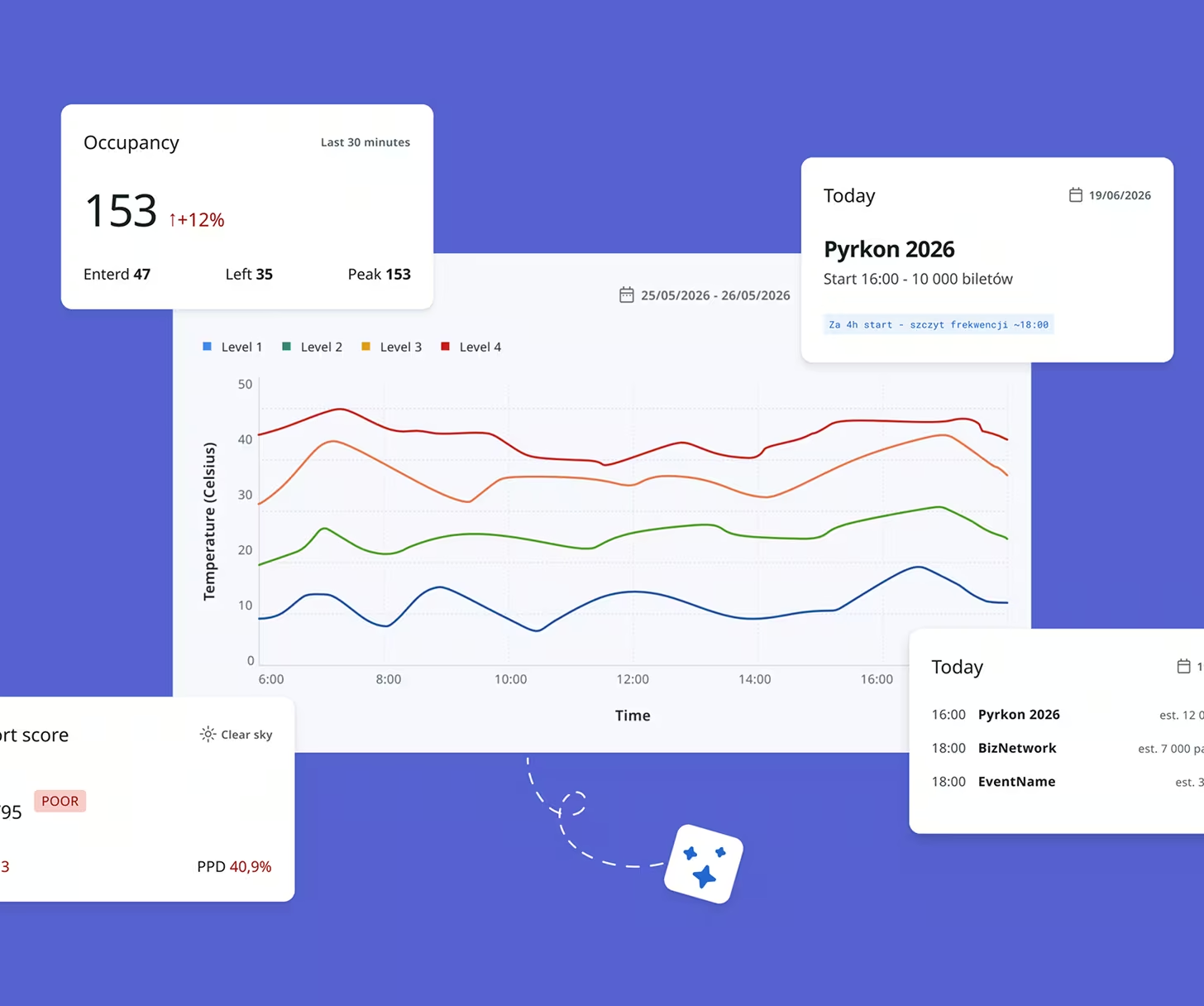
For Poznań International Fair, we built an AI-powered monitoring platform for the East Hall - a fully glazed 22-metre public space where weather directly affects indoor comfort. 24 sensors, thermal cameras, and LiDAR feed live data into a single user-facing app - with a custom-trained AI model counting people in real time and a predictive layer analysing environmental patterns to forecast indoor conditions.
Watch the video
Name
Poznań International Fair
Country
Poland
Company size
201-500 employees
Result
Live environmental monitoring, real-time crowd detection via custom AI model, and predictive modelling - connected into one user-facing app.
This is what AI integration looks like in practice - not a chatbot, but a system that monitors environmental conditions across a live venue and tells you what's going to happen before it does.
Miłosz Kusiciel
Head of Technology, Merixstudio
Our AI integration services
.avif)
AI layer for existing products
For products, platforms, or internal systems that already exist and need AI capabilities added to the current architecture.
Add predictions, intelligent alerts, AI search, recommendations, workflow automation, or knowledge assistants without rebuilding the entire product.
.avif)
New product with AI built in
For new digital products where AI features are planned from the start - as part of the product logic, user experience, data flows, and technical architecture.
Design data-heavy platforms, connected systems, operational tools, or knowledge-based products where AI is embedded into the product from day one.
.avif)
AI-augmented delivery
For teams that want a development partner who already uses AI in a measured, responsible way across the full engineering process.
From Spec Driven Development to AI-assisted code review, QA, and test automation - AI is already part of how we build, not a feature we promise to add.
Embedded AI assistance that surfaces relevant information, suggests next steps, or automates repetitive actions - without changing how the product fundamentally works.
Search that understands context, not just keywords - connecting AI with your documentation, knowledge bases, and internal systems to return accurate, source-backed answers.
Conversational interfaces that give employees fast access to company knowledge - procedures, policies, product documentation - without having to know where to look.
Automated processing of unstructured documents - extracting key data, classifying content, and routing it to the right place without manual handling.
End-to-end automation of repetitive business processes with human-in-the-loop checkpoints for steps that require judgment, approval, or accountability.
Natural language interfaces layered on top of complex platforms - letting users interact with data, trigger actions, or get answers without navigating complicated UIs.
IoT and sensor data platforms
We integrate AI with connected environments based on device APIs, MQTT, cloud data pipelines, and continuous sensor streams. This can support anomaly detection, event correlation, predictive insights, intelligent alerts.
Technologies: MQTT, device APIs, cloud data pipelines, AWS, data processing backends.
Cloud infrastructure and backend systems
We connect AI capabilities with backend logic, cloud services, APIs, and scalable infrastructure needed to process data, trigger workflows, and serve AI features reliably in production environments.
Technologies: AWS, Docker, Kubernetes, backend APIs, microservices, CI/CD pipelines.
Dashboards, analytics, and reporting layers
We embed AI into analytics and visualization layers to make complex data easier to understand and act on - AI-enhanced insights, reporting support, anomaly explanations, alert prioritization, and decision-support views.
Technologies: dashboards, reporting interfaces, alerting systems, data visualization layers, analytics backends.
User-facing web and mobile applications
We integrate AI directly into the interfaces people use every day - customer portals, operational tools, mobile apps, and internal platforms. This helps turn AI capabilities into usable product features, not disconnected experiments.
Technologies: React, Next.js, Flutter, portals, mobile apps, operational interfaces, customer-facing applications.
External APIs and third-party platforms
We connect AI with external services and platform APIs to enrich product logic, automate workflows, and combine AI outputs with broader system context.
Technologies: Google Maps, Mapbox, Strapi, Contentful, external APIs, CMS platforms, search and content systems.
Business systems and internal knowledge bases
We integrate AI with company knowledge and operational systems to support RAG, AI search, assistants, copilots, document workflows, and process automation.
Technologies: CRM, ERP, DMS, internal knowledge bases, documentation repositories, communication platforms.
Where AI makes sense
We work best with teams that want to bring AI into products and delivery in a way that is useful, measured, and grounded in real needs.
You need a software team that knows how to work with AI
You want a delivery partner who uses AI consciously - one that knows where it accelerates work and where it introduces risk, and adjusts accordingly.
You want to add AI to an existing product
You already have a working system and want to extend it with predictions, alerts, AI search, or assistant-like features.
You are exploring whether AI makes sense at all
You need a partner who can help evaluate the use case, data readiness, and architecture before making AI part of the roadmap.

You are modernizing a system and want it to be AI-ready
You may not need AI features today, but you want the software architecture to support them in the future.
Not sure where AI fits in your product?
We can help you evaluate the use case, assess your data readiness, and define what makes sense before any development begins.
Let's talk
.avif)
See how we used AI to turn an IoT concept into a working app prototype


350+
clients globally
81/100
quarterly NPS tracking
4.8/5.0
rated by 96 Clients
How AI-augmented delivery already improves our work
Our teams use AI across day-to-day delivery workflows, from coding and testing to analysis and documentation. We track its impact through DORA metrics, and on selected tasks it can accelerate delivery by up to 25%.
See how we use AI
.avif)
Does that work? Don’t take just our word for it!
Our company has talented engineers (...), but we lack experience in UX and UI. Engineers and scientists see the world differently, and our software is for regular people or technically inclined people (...). Your expertise helps us create more usable products for a broader audience, rather than just the structured, technical approach of our team members.

Ben Huddleston
Senior Engineer, Biocore

Your service helps us make more informed decisions. Often, our initial idea isn’t what 95% of users would prefer, so your objectivity is crucial. Without your team, we wouldn’t be able to innovate or release new features as frequently as we do.
Product Owner, HYDAC Group

We had changing requirements and changing team members but we always found a fast replacement in short terms - you always were able to respond. You always had devops, solution architects - people with different expertise available.

Dr Michael Auth
Project Manager in Research & Development, RP Group

What Merix has been capable of is basically to look at what we’re saying, understand not what we’re asking for, but what the idea behind what we're asking for is. And that way they’ve able to understand our needs and our processes to develop a product that is correct for us rather than just to do what we say.

Alex Sloth
Head of After Sales Services, Farmdroid

Merixstudio helps me solve problems and presents solutions in an easy-to-use, performant package. The software is simple, making it easier to understand complex things. The ultimate goal is not just building software but creating something that people use and that has downstream effects.
Ben Huddleston
Senior Engineer, Biocore
The stack behind practical AI integration
.webp)
.webp)
.webp)
.webp)




Industries we build AI solutions for
Facility Management & PropTech
AI-enhanced platforms for building operations, environmental monitoring, and connected infrastructure management in commercial and public spaces.
Enterprise & Knowledge Management
AI search, knowledge assistants, and document automation for organizations managing large volumes of internal information and complex workflows.
SportsTech
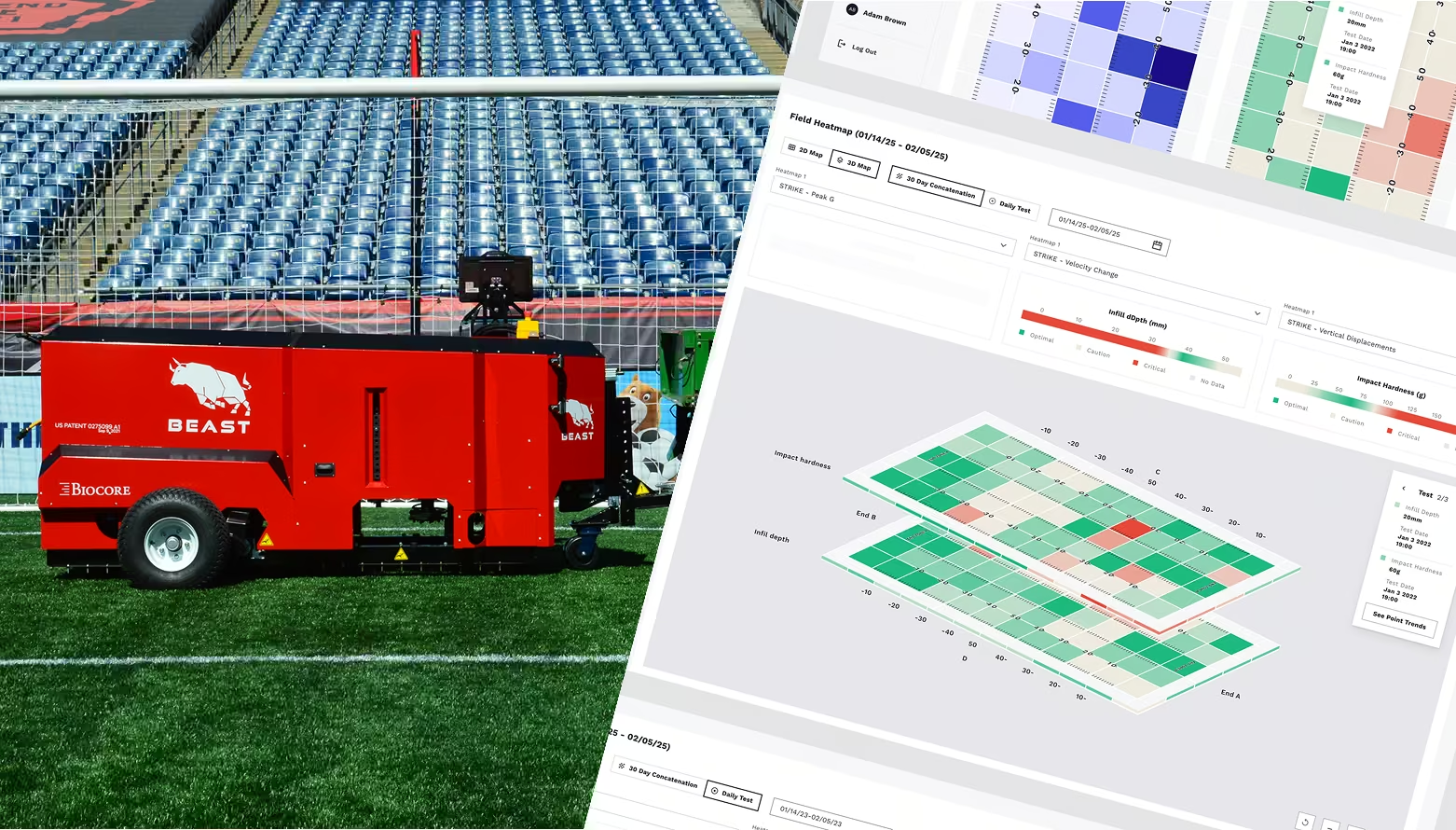
Tools for biomechanical data processing, performance analysis, and AI-supported insights for professional sports and research environments.

Healthcare & MedTech
AI-assisted interfaces for clinical data analysis, patient monitoring, and medical equipment management - with privacy and compliance built in.

Industrial & Manufacturing
Software for predictive maintenance, production line monitoring, and AI-supported quality control in industrial environments.
Sustainability & ClimateTech
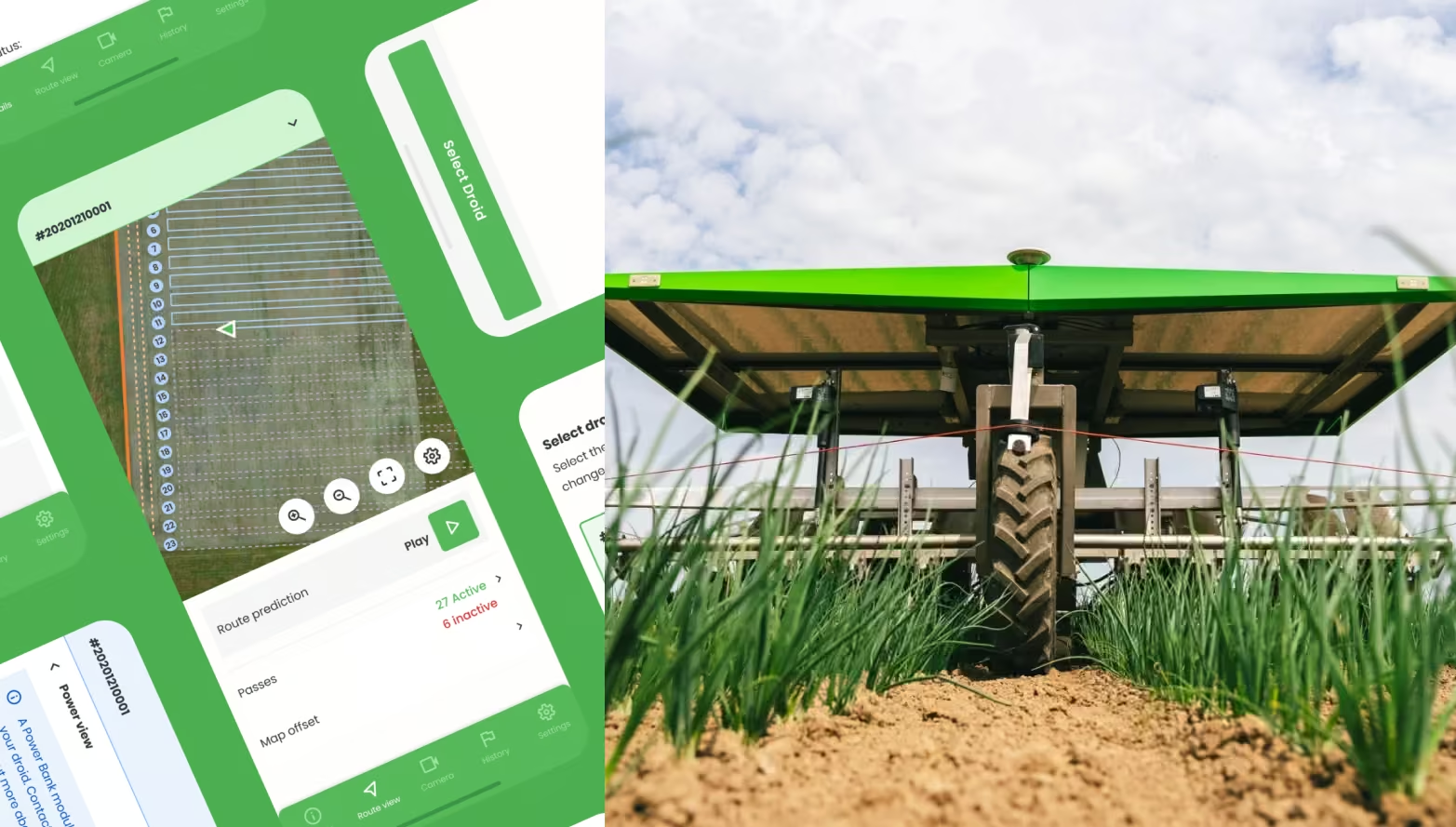
Remote monitoring and AI-supported automation for agricultural machinery and field operations - turning sensor data into operational decisions.

What makes our AI development secure and responsible
Human-in-the-loop by default
AI supports workflows, but people stay in control - especially in decisions that matter.
Security by design
AI-generated code and related delivery outputs go through the same quality and security checks as the rest of the software lifecycle.
ISO-backed processes
Our work is supported by ISO 27001 and ISO 9001 certified processes, covering both information security and quality management.
Fallback logic and control
We design systems so they degrade gracefully when AI output is insufficient, unavailable, or uncertain.
Access boundaries and operational clarity
We apply role-based access, context control, and clear integration boundaries to keep AI useful without making systems harder to trust.
Measured impact and observability
We monitor how AI affects quality, speed, cost, and delivery outcomes - so decisions around AI stay grounded in evidence, not assumptions.
Experience bridging hardware and software
we know how to work alongside embedded teams and hardware partners.
Clutch's No. 1 software company
independently rated and verified by real client reviews.
25+ years helping innovators
25+ years of helping mid-size and enterprise companies build and scale digital products - across Europe, the Middle East, and the US".
ISO 27001 & ISO 9001 certified
information security and quality management built into our processes.
AI-augmented delivery
our teams use AI across development workflows, from coding and testing to analysis and documentation, accelerating delivery by up to 25%.
Oops! Something went wrong while submitting the form.




Frequently asked questions about AI integration
AI integration services cover the process of embedding artificial intelligence capabilities into existing software products, business systems, and workflows. This isn't about building AI for its own sake - it's about identifying where AI can make a meaningful difference and connecting it with the right data, infrastructure, and user interfaces. In practice, AI integration can include adding predictions, intelligent alerts, or recommendations to user-facing applications, building knowledge assistants and RAG systems on top of internal documentation, automating repetitive workflows with human-in-the-loop checkpoints, and connecting AI with backend systems, APIs, cloud infrastructure, and data pipelines. The goal is AI that works inside real operating environments - not disconnected experiments.
We build custom AI solutions that help businesses improve workflows, unlock value from data, and add practical intelligence to digital products. The most common types include AI copilots embedded inside existing products, enterprise search and RAG systems that make company knowledge easier to access, knowledge assistants for internal teams, document extraction and classification systems, AI workflow automation with human review for sensitive processes, and conversational interfaces for complex systems. Every solution is designed around a specific use case - whether it's an internal tool for a small team or enterprise AI solutions supporting operations across multiple departments - and integrated into existing architecture, not delivered as a standalone tool that requires users to change how they work.
AI consulting services typically focus on strategy, assessments, and recommendations - helping you understand where AI could be useful. AI integration goes further: it includes the actual design, development, and deployment of AI capabilities inside your products and systems. We offer both. On the consulting side, we help evaluate use cases, assess data readiness, define architecture, and plan implementation. On the integration side, we build the AI features, connect them with your infrastructure, design user-facing interfaces around them, and support them in production. For teams exploring generative AI consulting services specifically, this includes evaluating which generative AI capabilities (RAG, assistants, content generation) fit your product and operational context - and then building them.
RAG (Retrieval-Augmented Generation) is an architecture where an AI model retrieves relevant information from your own data sources - documentation, knowledge bases, internal procedures, product manuals - before generating an answer. This means the AI responds based on your actual company knowledge, not just general training data. RAG makes sense when your teams spend significant time searching for information across scattered documents and systems, when you want an AI assistant or chatbot that gives accurate, source-backed answers instead of generic or hallucinated responses, or when you need ai enterprise search that understands context, not just keyword matching. We build RAG systems as part of our AI chatbot development services - connecting them with your internal knowledge bases, CRMs, documentation repositories, and other business systems.
We start with an AI readiness assessment - not with a solution. This means evaluating your current systems, data quality, existing workflows, and business goals to identify where AI can create real value versus where it would add complexity without meaningful return. We look at what data you already have and whether it's usable, which workflows involve repetitive decisions or pattern recognition, where users currently struggle with information overload or manual processing, and whether your technical architecture can support AI capabilities without a complete rebuild. The output is a clear picture of what's worth pursuing, what needs preparation first, and what doesn't make sense right now - honest guidance before any commitment to development.
Yes - this is one of our two primary engagement models. For products, platforms, or internal systems that already exist, we add AI capabilities to the current architecture without rebuilding the entire product. This can include predictions, intelligent alerts, AI-powered search, recommendations, workflow automation, or knowledge assistants layered on top of what you already have. We work with your existing tech stack - whether that's a web application built in React, a mobile app in Flutter, a backend in Python or Node.js, or cloud infrastructure on AWS. The key is finding the right integration points where AI adds value without creating instability or forcing users to relearn how the product works.
Yes - our second engagement model is building new digital products where AI features are planned from the start, as part of the product logic, user experience, data flows, and technical architecture. This is the right approach when AI isn't a bolt-on feature but a core part of how the product works - for example, data-heavy platforms that rely on predictions or anomaly detection, knowledge-based products built around RAG and AI search, or operational tools where AI-driven automation is central to the value proposition. In these cases, we design the AI architecture alongside the product architecture from day one, so data pipelines, model integration, user interfaces, and governance are aligned from the beginning.
We integrate AI across the full technology stack - not just at the application layer. This includes IoT and sensor data platforms (MQTT, device APIs, cloud data pipelines) for anomaly detection, predictive insights, and intelligent alerts; cloud infrastructure and backend systems (AWS, Docker, Kubernetes, microservices) for processing, triggering workflows, and serving AI features in production; dashboards, analytics, and reporting layers for AI-enhanced insights and decision support; user-facing web and mobile applications (React, Next.js, Flutter) where AI becomes a usable product feature; external APIs and third-party platforms (Mapbox, CMS systems, content platforms) for enriching product logic; and business systems and internal knowledge bases (CRM, ERP, DMS) for RAG, AI search, assistants, and process automation.
We build AI responsibly by default, not as an afterthought. Our approach includes human-in-the-loop design - AI supports workflows, but people stay in control, especially in decisions that matter. AI-generated code and delivery outputs go through the same quality and security checks as the rest of the software lifecycle. Our work is supported by ISO 27001 and ISO 9001 certified processes covering both information security and quality management. We design systems with fallback logic so they degrade gracefully when AI output is insufficient, unavailable, or uncertain. And we apply role-based access, context control, and clear integration boundaries to keep AI useful without making systems harder to trust. For organizations that need a more structured ai governance framework, we help define policies, guardrails, and monitoring practices as part of the implementation.
We adapt the collaboration model to your AI maturity and project stage. This can range from a focused AI readiness assessment or proof of concept to full-scale product development with AI built in, or long-term evolution of AI capabilities in an existing product. Whether you need a cross-functional team, a fixed-scope delivery, expert consultation, or ongoing maintenance support, we tailor the engagement to your technical complexity and internal capabilities. Most AI integration projects start smaller - with an assessment or a focused use case - and expand as the value becomes clear.
Look for a partner that starts with the use case, not the technology. Many AI implementation services lead with models and tools - the right partner leads with your business context, data readiness, and user needs. Ask whether they can evaluate if AI makes sense before committing to building it. Ask how they handle governance, security, and fallback logic. Check whether they have experience integrating AI into existing products (not just building standalone demos), and whether they bring product design and UX capability alongside engineering - because AI that's technically sound but unusable is still a failed investment. A good AI software development company is honest about where AI creates value and where it doesn't.
AI integration at Merixstudio sits within our Software Engineering pillar, alongside enterprise software development, web and mobile development, and custom software for IoT. This means AI capabilities are built by the same engineering teams that build the products themselves - not by a separate AI lab handing off models that don't fit the architecture. Within Modernization & Optimization, we help prepare existing systems for AI readiness - restructuring data pipelines, improving architecture, and modernizing interfaces so AI features have a solid foundation. And within Product Discovery, Design & Experience, we conduct the research and design work that ensures AI features are shaped around real user needs and workflows, not just technical possibilities.
AI enterprise solutions fail more often than most vendors admit - and the reasons are rarely technical. Common causes include starting with the technology instead of the problem, building on data that isn't clean or accessible enough, designing AI features without understanding user workflows, underestimating the need for governance and fallback logic, and treating AI as a standalone project disconnected from the rest of the product. We prevent these failures by starting every engagement with an honest assessment of whether AI makes sense for the specific use case. We evaluate data readiness before committing to a model. We design with human-in-the-loop checkpoints for sensitive processes. And we integrate AI into existing products and workflows rather than delivering isolated proofs of concept that never reach production.
Our AI-related work spans several industries, including smart infrastructure and facility management (a platform bringing together environmental sensors, air quality data, thermal readings, and movement insights into one AI-enhanced management interface with privacy-by-design principles), biomechanical engineering (enabling engineers to analyze impact data four times faster through advanced data processing and visualization), precision agriculture (real-time communication and AI-supported monitoring for autonomous field robots), and sports technology (combining data visualization with field analysis for researchers and field managers). What connects these projects is the shared pattern: complex data environments where AI helps turn raw information into operational value - with clear interfaces, reliable processing, and responsible data handling.
Building AI-enabled products involves two layers of AI: the AI features inside the product, and AI used in the delivery process itself. We apply both. Our AI-augmented delivery model embeds AI into day-to-day AI software development services - code generation, testing, debugging, documentation, and analysis - to reduce repetitive work and accelerate delivery of the product you're paying for.
To keep both layers disciplined, we follow Spec Driven Development: every feature - whether it's a RAG system, an AI-powered alert, or a standard UI component - starts with a validated specification and acceptance criteria before implementation. Engineers act as architects and reviewers throughout, ensuring AI operates within clear guardrails in both the product and the delivery process.
We measure the impact through DORA metrics, giving clients clear visibility into how AI supports faster delivery, fewer bugs, and shorter feedback loops. Based on feedback from our entire engineering team, AI can accelerate selected tasks such as code generation, debugging, refactoring, and test automation by up to 25%.
Every AI tool we use is vetted by our technical and legal teams and governed by clear internal security policies. In our latest internal survey, 94% of team members confirmed awareness of data security rules for AI usage, and no project data is ever used to train external models.
.svg)
.svg)
.svg)
.avif)

.avif)
.avif)
.avif)
