.svg)


Software Security Enhancement
Protect your software from the inside out: expert security enhancement, ISO 27001-certified and backed by clear AI governance policies.





Advanced strategies for comprehensive digital protection
In today’s digital landscape, merely deploying standard security measures is no longer sufficient. Achieving true cybersecurity resilience demands a strategy that is as dynamic and nuanced
as the threats themselves.
At Merixstudio, our expertise in software security goes beyond basic measures. We delve into your systems, conducting thorough explorations and controlled simulated attacks to uncover and fortify against vulnerabilities. This comprehensive process not only identifies risks but also shapes effective, customized security strategies.
Partner with us for a security-first approach, ensuring your software solutions are not just innovative but also resilient against evolving cyber threats.
Protect sensitive data
Safeguard critical information from unauthorized access
and cyber threats.
Detect vulnerabilities early
Identify and rectify potential security issues before they escalate into serious problems.
Prevent financial losses
Avoid costly data breaches and mitigate the risk of financial penalties and lawsuits.
Comply with regulations
Adhere to legal and industry standards, including the NIS2 Directive, for data security and privacy.
Ensure business continuity
Maintain seamless operations and minimize downtime
by defending against security breaches.
Build customer trust
Enhance confidence in your product by ensuring a secure user experience.

System for safety lighting management
Making the management of emergency lighting systems easier with an intuitive web platform.


Their flexibility stands out. Additionally, their design and frontend development have been very fast. I expected the work to take much more time, but their resources are great.
Strategies for enhancing software security
Delivering software security means crafting a strategy that is as unique as your business. We handpick and customize renowned tools and methodologies, crafting a cohesive and robust defense that is precisely aligned with your specific requirements.

Engaging in rigorous penetration testing, we dissect your security infrastructure, ensuring adherence to data protection mandates such as GDPR, HIPAA, and PCI DSS. Employing a selection of customized tools and technologies, we bolster your defenses against potential breaches, adjusting our approach to each specific case.

Proactively confronting cybersecurity risks, our penetration testing employs tools like nmap and OpenVAS to preemptively seal security gaps, fortifying your cyber resilience.

Utilizing an array of tools, including sqlmap and Nikto, our penetration testing meticulously spots and evaluates weaknesses, aligning with standards like OWASP ASVS to ensure thorough safeguarding of your digital ecosystem.


Simulating advanced cyber-attack scenarios, we employ penetration testing with Postman and dirb to identify soft spots, enhancing your security protocols, and preventing unauthorized intrusions.
.webp)
Our penetration testing advocates for a culture of constant security alertness. Leveraging tools like Nikto and OpenVAS, we initiate a cycle of continuous assessment and improvement, establishing enduring defense mechanisms against evolving cyber threats.

We conduct a detailed analysis of your patch deployment strategies through penetration testing. This approach yields critical insights, enhancing your capabilities to manage and implement essential updates effectively.
.webp)
We seamlessly integrate security practices into every stage of the software development lifecycle (SSDLC), encompassing requirements gathering, design, coding, testing, and deployment. This proactive approach enables us to identify and eliminate potential threats early on, preventing them from evolving into critical issues.
Planning
and
scoping


Reconnaissance & information gathering
Vulnerability scanning & analysis
Exploitation and penetration testing
Reporting and remediation recommendations

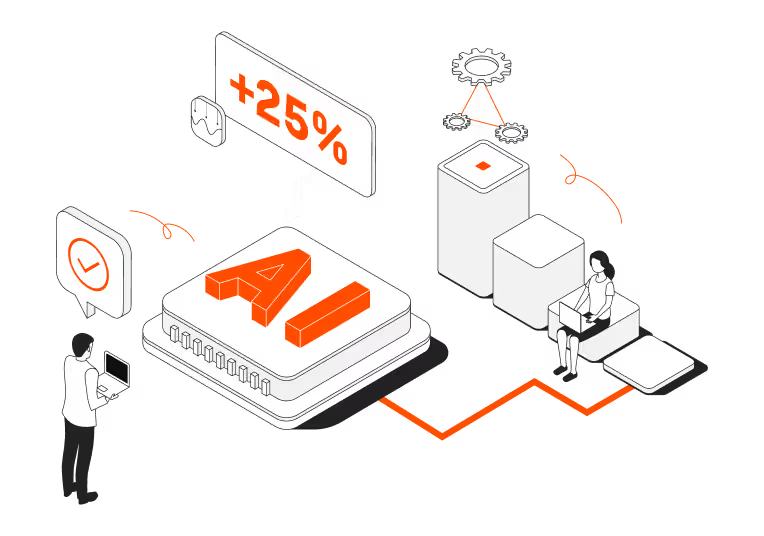
AI-augmented delivery with measurable impact
Our teams use AI across day-to-day delivery workflows, from coding and testing to analysis and documentation.
We track its impact through DORA metrics, and on selected tasks it can accelerate delivery by up to 25%.
Expert advice for informed strategies


Frequently asked questions
Software security enhancement is the process of identifying, assessing, and remediating vulnerabilities in your software systems - and building security practices into how your software is developed, maintained, and operated. It goes beyond one-time fixes: it involves penetration testing, vulnerability scanning, security code review, compliance assessment, and integrating security into the software development lifecycle so that new vulnerabilities don't emerge with every release. The goal is a security posture that is proactive, measurable, and aligned with your business risk profile - not just reactive patching after something goes wrong.
Our application security testing services cover the full cycle of identifying and addressing vulnerabilities in your web and mobile applications. This includes automated vulnerability scanning using tools like OpenVAS and Nikto, manual penetration testing to uncover issues that automated tools miss, web application security testing aligned with OWASP ASVS standards, security code review to identify weaknesses at the source level, and a comprehensive report with prioritized remediation recommendations. We test against real attack scenarios - not just theoretical checklists - to give you a clear picture of what an attacker could actually exploit.
A vulnerability assessment identifies and catalogs known weaknesses in your systems using automated scanners - it tells you what could be exploited. Penetration testing goes further: it actively attempts to exploit those vulnerabilities to demonstrate real-world impact - it tells you what can be exploited and how far an attacker could get. In practice, vulnerability assessment and penetration testing work best together. We typically start with a vulnerability assessment to map the attack surface, then conduct targeted penetration testing on the highest-risk areas. This combined approach gives you both breadth (comprehensive scanning) and depth (real exploitation evidence) in a single engagement.
A key component of our software security enhancement service is ensuring your software meets relevant data protection and compliance standards. We conduct penetration tests and security assessments designed to evaluate your compliance posture against frameworks like GDPR, HIPAA, PCI DSS, and the NIS2 Directive. For organizations building or maintaining gdpr compliance software, we assess data handling practices, access controls, encryption, and data retention mechanisms. For healthcare companies that need hipaa compliant software development, we evaluate protected health information (PHI) safeguards and recommend architectural improvements. Our security audit services provide documented evidence of your compliance efforts - useful for regulatory reviews, client due diligence, and internal governance.
Our process has five phases. Planning and Scoping defines the scope, business goals, risk profile, and communication plan. Reconnaissance and Information Gathering maps your systems, networks, and applications to identify potential attack vectors and entry points. Vulnerability Scanning and Analysis uses automated scanners combined with manual testing to identify and prioritize vulnerabilities based on risk and business impact. Exploitation and Penetration Testing actively attempts to exploit vulnerabilities - testing privilege escalation, lateral movement, and incident response. Reporting and Remediation delivers a comprehensive software security assessment with root causes, prioritized recommendations, and guidance on implementing fixes. Each phase can also serve as a standalone web application security assessment when the scope is focused on a specific application. We work closely with your team throughout to minimize disruption.
Timelines depend on the scope and complexity of your environment. A focused web application penetration testing engagement for a single application typically takes 1–3 weeks. Mobile application testing - covering both iOS and Android - runs on a similar timeline, depending on the number of platforms and API integrations involved. A broader software security assessment covering multiple web and mobile applications, APIs, and infrastructure can run 3–6 weeks. For organizations that need ongoing security monitoring and periodic reassessment, we offer continuous engagement models. We set realistic timelines during the planning phase to ensure thorough testing without disrupting your operations - and we deliver actionable results at each stage, not a single report at the end.
To begin a security assessment, we need a clear understanding of what you want tested - specific applications, APIs, infrastructure, or the full software environment. Access credentials (for authenticated testing), architecture documentation, and information about your tech stack help us scope the engagement accurately. If you're pursuing compliance certification, we need to know which frameworks apply (GDPR, HIPAA, PCI DSS, NIS2). The most important input is your risk profile: what data do you handle, what are the consequences of a breach, and what security measures are already in place. This lets us focus testing where the business risk is highest.
A secure SDLC integrates security practices into every stage of the software development lifecycle - from requirements gathering and design through coding, testing, and deployment. Instead of treating security as a final checkpoint, it builds security in from the start. We implement secure SDLC practices across all our development projects: threat modeling during architecture design, secure coding standards during development, automated security scanning integrated into CI/CD pipelines (using tools like Semgrep and Trivy), security-focused code review, and penetration testing before production release. This proactive approach catches vulnerabilities early - when they're cheapest and easiest to fix - rather than discovering them in production.
We embed automated security scanning directly into your CI/CD pipelines so that every code change is checked for vulnerabilities before it reaches production. This is a core part of our devsecops services - DevSecOps being the practice of embedding security (Sec) into development (Dev) and operations (Ops) as a continuous, automated discipline rather than a separate phase. In practice, this includes static application security testing (SAST) using tools like Semgrep to analyze source code, container image scanning using Trivy to check for known vulnerabilities in dependencies and base images, and automated checks against security policies defined for your project. When a scan flags an issue, the pipeline can block deployment until it's resolved - or flag it for review depending on severity. This approach makes security a continuous, automated part of delivery rather than a periodic manual exercise.
Yes. Cloud application security is a core part of our security enhancement work. Cloud-hosted applications face specific security challenges: misconfigured cloud services, overly permissive IAM roles, exposed APIs, insecure storage buckets, and gaps between cloud provider defaults and actual security requirements. We assess your cloud security posture, test for cloud-specific vulnerabilities, and recommend architectural improvements. Our team has experience with AWS environments and understands how to configure infrastructure, networking, and access controls to meet security best practices. We also help ensure that cloud deployments align with compliance frameworks relevant to your industry.
When we discover vulnerabilities, we deliver a detailed report that includes the root cause, the potential business impact, evidence of exploitation (where applicable), and specific remediation recommendations prioritized by severity and risk. We don't just hand over a list - we work with your development team to explain findings, clarify priorities, and guide the remediation process. For critical vulnerabilities, we provide immediate notification so you can take action before the full report is complete. After remediation, we offer re-testing to verify that fixes are effective and haven't introduced new issues. Our vulnerability scanning services include follow-up assessments to ensure your security posture improves over time, not just in response to a single engagement.
When evaluating a penetration testing company, look for a team that goes beyond running automated scanners. The right partner combines automated tools with manual testing techniques, understands your business context and risk profile (not just technical configurations), provides actionable remediation guidance (not just a list of CVEs), and can work with your development team to fix issues - not just find them. Ask about their methodology (OWASP, PTES), whether they provide re-testing after remediation, and whether they can also help you build security into your development process long-term. A good application security consulting partner helps you get more secure over time, not just pass a single assessment.
The frequency and sophistication of cyber attacks are increasing, and the consequences of a breach - financial losses, regulatory penalties, reputational damage, business disruption - are more severe than ever. For businesses that handle sensitive customer data, operate in regulated industries, or rely on digital products as a core part of their operations, software security isn't optional. Security risk assessment and proactive security enhancement protect not just your data but also your customer trust, your compliance standing, and your ability to operate without interruption. Investing in security before a breach happens is significantly less expensive than responding to one after the fact.
Software security enhancement is most valuable for organizations that handle sensitive customer or business data, operate in regulated industries (financial services, healthcare, manufacturing, energy), have web or mobile applications exposed to the public internet, are preparing for compliance certification (ISO 27001, SOC 2, GDPR), or have experienced security incidents and need to strengthen their posture. Mid-sized and enterprise organizations with custom software products particularly benefit - because custom applications don't get security patches from a vendor; the security responsibility is entirely on you and your development partner.
AI-augmented delivery improves security in two ways: it makes our development process more secure, and it helps us deliver security-focused work faster. In our day-to-day engineering, AI assists with identifying potential security issues during code review, generating test cases for edge cases and security scenarios, and flagging patterns that commonly lead to vulnerabilities. To keep AI itself disciplined and secure, we follow Spec Driven Development: every feature starts with a validated specification before implementation, and engineers review all AI-generated output against security requirements.
On the governance side, every AI tool we use is vetted by our technical and legal teams and governed by clear internal security policies. In our latest internal survey, 94% of team members confirmed awareness of data security rules for AI usage, and no project data is ever used to train external models. Our work is backed by ISO 27001 and ISO 9001 certified processes - the same standards that govern our security enhancement services also govern how we use AI in delivery.
.svg)
.svg)
.svg)
.avif)

.avif)
.avif)
.avif)
