.svg)


Customer Experience Transformation Services
Design sprints, CX audits, and digital touchpoint optimization - backed by UX research and software engineering.





Strategic approach to designing impactful experiences
Many businesses realize that competing solely on products or services isn't enough. Gaining a lasting competitive edge requires seeing the world through the customer’s eyes.
At Merixstudio, we specialize in creating value through transforming the customer experience. By delving deep into the heart of customer interactions, we guide companies toward strategic decisions that impact their customer relationships and drive business growth.
Partner with Merixstudio to redefine your customer experience.
Adapt to market changes
Stay agile and responsive to evolving market trends and customer expectations.
Maximize customer satisfaction
Actively address customer needs to boost loyalty and retention.
Increased revenue
Leverage positive customer experiences to drive sales and repeat business.
Enhance brand reputation
Utilize exceptional customer experiences to build a stronger, more attractive brand presence.
Differentiate competitively
Stand out in the market by offering superior customer experiences.
Streamline processes
Optimize customer-related processes for efficiency and cost reduction.
.webp)
Customer platform for solar manufacturer
Improving the customer experience with a high-quality custom web platform yields a 30% surge in sales of innovative solar tiles manufacturer.


Digitalization is the central element of our future evolution. We leverage the expertise of Merixstudio in setting up our digital services for customers, which allows us to focus on what we do best: designing, engineering, and manufacturing climate tech in Europe. Merixstudio's growing understanding of solar energy significantly supports our mission as it enhances the efficiency of our processes and accelerates our time to market, an element that is always high on the agenda.
Strategies for improving customer experience
Prioritizing your experience, our approach combines
a range of proven methodologies, enhancing every interaction with your business.
Consequently, each methodology is carefully adapted to align seamlessly with your unique requirements and objectives.

Employing the Business/Lean Model Canvas, we map out business models to gain a comprehensive understanding of your current operational landscape. This framework is instrumental in clarifying and contextualizing your business processes.
Utilizing the Value Proposition/Elevator Pitch technique, we articulate the unique advantages your business offers. This approach is pivotal in ensuring your value proposition is communicated effectively and memorably in the market.

A combination of survey interviews, focus group analysis, and analytics tools is used to acquire comprehensive market and customer insights. This approach ensures a deep understanding of market needs and trends.

Through brainstorming, we enhance creative thinking and idea generation, essential for a forward-thinking CX strategy, aiming at innovative solutions for unique challenges.
By employing Customer Journey Mapping and Service Blueprint Mapping, we deeply analyze user interactions, forming a user-centered strategy foundation. Leveraging Lean UX principles, we prioritize agility and responsiveness, focusing on rapid prototyping and continuous feedback to develop efficient and impactful technology solutions.

In our Design Sprints, we prototype and test rapidly, speeding innovation and reducing failure risk, crucial for swiftly bringing viable concepts to life.
Integrating Design Thinking into our problem-solving methodology, we focus on user-centricity to develop resonant prototypes. With Lean UX, we iterate fast based on feedback, refining designs to meet user needs. Storyboarding visually outlines the user experience, offering a clear narrative of interactions, key for conceptualizing and communicating the journey.
Introductory Session


CX Analysis & Workshops
Prototyping
Improvements / Development

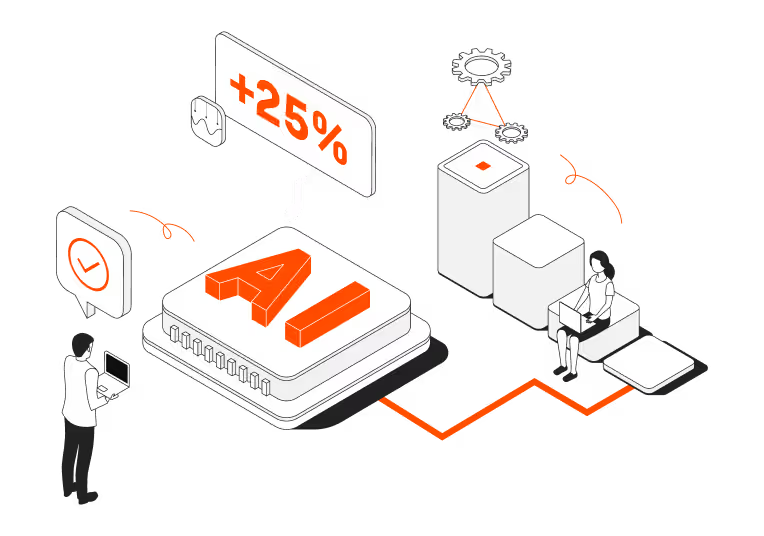
AI-augmented delivery with measurable impact
Our teams use AI across day-to-day delivery workflows, from coding and testing to analysis and documentation.
We track its impact through DORA metrics, and on selected tasks it can accelerate delivery by up to 25%.
Expert advice for informed strategies




Frequently asked questions
Customer experience transformation is the process of rethinking and redesigning how customers interact with your business across digital touchpoints and channels. It goes beyond UI improvements or customer service fixes. CX transformation involves understanding the current state of your customer journey, identifying where friction, confusion, or missed opportunities exist, and making strategic changes to how your product, processes, and systems serve the people who use them. This can include customer journey mapping, digital touchpoint redesign, service blueprint development, prototyping, and connecting CX improvements to measurable business outcomes like retention, satisfaction, and revenue growth.
Our customer experience consulting services combine research, strategy, and hands-on design to improve how your customers experience your product and brand. This includes mapping and analyzing the current state of your customer journey using Business Model Canvas, value proposition workshops, and as-is process mapping. We conduct market research through survey interviews, focus group analysis, and analytics to understand customer behavior and expectations. From there, we develop a CX vision and strategy using customer journey mapping, service blueprints, and Lean UX principles. We then move into prototyping through design sprints and design thinking - creating and testing solutions before committing to full development. As a customer experience consulting firm, we don't stop at recommendations - we can also implement the improvements through our development capabilities.
Customer experience design is the practice of shaping every interaction a customer has with your business - from the first touchpoint through long-term engagement. Customer experience strategy is the plan that guides those design decisions: it defines what experience you want to deliver, for whom, and how it connects to business goals. In our work, the two are inseparable. We start with strategy - understanding your business model, customer segments, and competitive landscape - and then translate that into concrete design decisions: journey flows, interface design, service touchpoints, and digital product features. A customer experience strategy without design execution stays on paper. Design without strategy produces beautiful solutions that may not solve the right problems.
Customer service is one touchpoint within the broader customer experience - it's what happens when a customer reaches out for help. Customer experience encompasses the entire journey: from how a customer discovers your brand, through their first interaction with your product, to onboarding, ongoing usage, support, and long-term loyalty. You can have excellent customer service but still lose customers because the product is confusing, the onboarding is unclear, or the digital experience doesn't meet their expectations. CX transformation addresses the full picture, not just the reactive support layer.
Our process has four phases. It starts with an Introductory Session where we learn about your business goals, current CX challenges, and objectives - resulting in a helicopter view of where you stand and a plan for next steps. Then we move into CX Analysis & Workshops: brainstorming sessions, as-is process mapping, business context analysis, market research, and competitor and customer analysis. The outcome is a clear understanding of your business needs and a roadmap for customer experience improvement - including milestones, risk scenarios, and a UX vision. Next comes Prototyping: we define scope, create wireframes and mockups, develop clickable prototypes, and test them with real end users. Finally, we move into Improvements and Development - implementing changes to the customer journey or starting product development, with estimation and timeline for the first phase.
Every digital customer experience is different because every business serves different customers through different channels. Our customization starts with understanding your specific business model, customer demographics, and market challenges. We analyze your existing digital touchpoints, assess your current digital experience strategy, and identify where the gaps are between what your customers expect and what they actually get. From there, we develop a tailored approach - which may focus on journey redesign, digital platform improvement, new feature development, service process optimization, or a combination of these. The scope and depth of the engagement adapts to your maturity level: some clients need a full CX overhaul, others need targeted improvements in specific parts of the journey.
To begin, we need access to people who understand your customers and your business - product owners, marketing leads, customer support managers, or anyone who can share insight into how customers currently interact with your brand. Existing data is extremely helpful: customer feedback, NPS scores, support tickets, analytics data, user research findings, or any documentation about your current customer journey. If you have none of this, that's also fine - our analysis phase is designed to gather it. The most important starting point is clarity on what's driving the need for change: declining customer satisfaction, competitive pressure, a product that's not converting, or a digital experience that no longer reflects your brand.
It depends on the scope. An introductory session and focused CX analysis with workshops typically takes 2–4 weeks. Adding prototyping - wireframes, mockups, and user testing - extends the timeline to 6–10 weeks. If the engagement continues into implementation and development, the full transformation can take 3–6 months or longer, depending on the complexity of the changes and the number of touchpoints involved. We deliver in phases, so you see tangible outputs at each stage - not a single report after months of analysis. Each phase builds on the previous one, so you can decide at every step whether to go deeper or pivot.
Both. This is one of the biggest differences between working with us and working with a pure CX consultancy. We don't hand you a strategy deck and leave. Our customer experience transformation process is designed to flow seamlessly from analysis and strategy through prototyping into actual development and implementation. We have the design, engineering, and product teams in-house to build what we recommend - whether that's a redesigned customer portal, a new mobile app, improved onboarding flows, or a completely reworked digital platform. This means no gap between insight and execution, and no need to re-brief a separate development team on what needs to be built.
Competing solely on product features or price isn't enough when customers have more alternatives than ever. Customer experience optimization directly impacts the metrics that drive growth: customer retention (it costs significantly less to keep a customer than to acquire a new one), conversion rates (a well-designed experience removes friction from the buying process), word-of-mouth referrals (satisfied customers recommend - dissatisfied customers warn), and customer lifetime value (better experiences lead to longer, more valuable relationships). Investing to improve customer experience isn't a cost center - it's a strategic decision that compounds over time through higher loyalty, stronger brand reputation, and measurable revenue impact.
When choosing a customer experience agency, look for a partner that combines research and strategy with the ability to actually build and implement customer experience solutions. Many agencies stop at journey maps and recommendations - the real value comes from turning insights into working products and measurable improvements. Ask whether they conduct real user research (not just stakeholder assumptions), whether they prototype and test before building, and whether they can take the work through to development. Also check for experience across different types of digital products - portals, apps, platforms - not just marketing touchpoints. CX transformation often requires changes to core product software, not just visual design or campaign optimization.
UX design focuses on how users interact with a specific product or interface - navigation, layout, usability, visual design. Customer experience transformation is broader: it looks at the entire relationship between a customer and your business across all touchpoints, channels, and stages. CX transformation often starts with ux audit services - evaluating the usability and effectiveness of your current digital products - but goes further to examine the full journey: awareness, onboarding, usage, support, renewal, advocacy. It also connects design decisions to business strategy and customer experience management - ensuring that improvements aren't isolated UI changes but part of a coherent approach to how your organization serves its customers.
We believe CX improvements should be measurable, not assumed. Our approach includes defining success metrics upfront - aligned with your business goals - and using customer experience analytics to track progress. This can include customer journey analytics that show how users actually move through your product or service (not just how you designed it), satisfaction and loyalty metrics like NPS and CSAT measured before and after changes, conversion and engagement data tied to specific touchpoint improvements, and qualitative feedback from user testing and interviews. We also prototype and test before building, which means you validate improvements with real users before committing development resources. The goal is data-driven decisions at every stage, not intuition-based redesigns.
Our CX transformation work spans several industries. In renewable energy and manufacturing, we helped Autarq - an innovative solar tile manufacturer - redesign their customer platform, resulting in a 30% surge in sales. The project combined deep understanding of a technical product with a digital experience that made it accessible to customers. In smart cities and urban management, we shaped the customer-facing experience for Expo City Dubai - a mobile super app serving citizens, residents, and visitors, featuring custom navigation, real-time updates, and architecture for 400,000 simultaneous users. In agriculture and field robotics, we designed the experience for FarmDroid - a remote management app for autonomous field robots where users range from highly technical operators to everyday farmers. What connects these projects is the shared challenge of making complex businesses feel simple and intuitive from the customer's perspective.
Customer experience projects generate large volumes of qualitative and quantitative data - interview transcripts, survey results, analytics, user test recordings, journey maps. AI-augmented delivery helps process and synthesize this faster, so teams spend more time on insight and strategy and less on manual analysis. In the research and analysis phases, AI supports pattern recognition, sentiment analysis, and domain mapping. In prototyping and development, AI accelerates implementation through Spec Driven Development - every design decision and feature starts with a validated specification before AI-assisted code generation, testing, and refinement.
Beyond the process, customer experience automation is increasingly relevant in the solutions we build: AI-powered personalization, intelligent routing, automated content suggestions, and predictive analytics that help anticipate customer needs before they become support tickets.
We measure the delivery impact through DORA metrics, giving clients visibility into how AI supports faster, more reliable delivery. Based on feedback from our entire engineering team, AI can accelerate selected tasks by up to 25%. Every AI tool is vetted by our technical and legal teams, 94% of team members confirmed awareness of data security rules for AI usage, and no project data is ever used to train external models.
.svg)
.svg)
.svg)
.avif)

.avif)
.avif)
.avif)
