.svg)


Product Discovery & Business Analysis Services
Validate your product idea, define realistic scope, and enter development with a plan you can trust.





From assumptions to a validated plan:
before development starts
Most software projects don't fail because of bad code - they fail because teams start building before they fully understand what they're building,
for whom, and why.
Our discovery and analysis engagements bring together product, design,
and engineering expertise to validate your assumptions, define realistic scope, and produce a development roadmap grounded in evidence - not guesswork. Our analysts use AI to accelerate research synthesis, pattern recognition, and documentation - so more time goes to strategic thinking and less to manual processing.
With over 130 scoping sessions and workshops behind us, we consistently see that teams who invest in structured discovery build faster, waste less, and ship products that actually perform.
Realistic scope and estimates
Know exactly what you're building, how long it will take, and what it will cost - based on structured analysis, not rough guesses.
Bespoke roadmap
Receive a phased plan with clear priorities, milestones, and dependencies - ready to hand to a development team or use for internal budget approval.
Value-driven recommendation
Get expert guidance on tech stack, architecture, and build-vs-buy decisions - tailored to your product's actual requirements, not generic best practices.
Concept validation
Challenge your initial ideas with experienced product, design, and engineering professionals who will identify opportunities and flag risks before they become expensive.
Test run
Start development with everyone - your stakeholders and our team - operating from the same understanding of goals, scope, users, and priorities.
Efficient kickoff
Skip the weeks of back-and-forth that typically slow down project kickoffs. Discovery produces the documentation, decisions, and clarity that let development begin immediately.
See how you can benefit
from discovery & analysis


Understand before building
Our workshops are custom-fit to meet our clients' unique needs, ensuring we grasp all requirements right from the start. Not sure which format is right for you? Start with a scoping recon - a short introductory session where you see how we work, we assess your project context, and you receive a list of unknowns, an initial ballpark estimation, and a recommended plan of next steps. From there, you can choose the format that fits your stage.

Scoping session
If you are well-versed with your product and need to estimate development costs, consider a scoping session.
This collaborative process aims to align all team members on the project's objectives, functionalities, and the necessary time and effort for successful delivery.
1-2 online or indoor sessions
(4-6h per session)

Product discovery & scoping
If you are looking for expert validation of your ideas to ensure your products meet real needs, consider product discovery & scoping.
It saves time and resources by resolving uncertainties early and concentrating on products with true demand.
3-4 online or indoor sessions
(4-6h per session)

Logic heavy custom workshop
If you are working on a project with many unknowns or complex business logic, consider custom workshops.
These extended engagements include deep analysis, event storming, business process mapping, and detailed architecture work - ensuring a seamless and well-informed transition into the development phase.
3-6 online or indoor sessions
(4-6h per session)
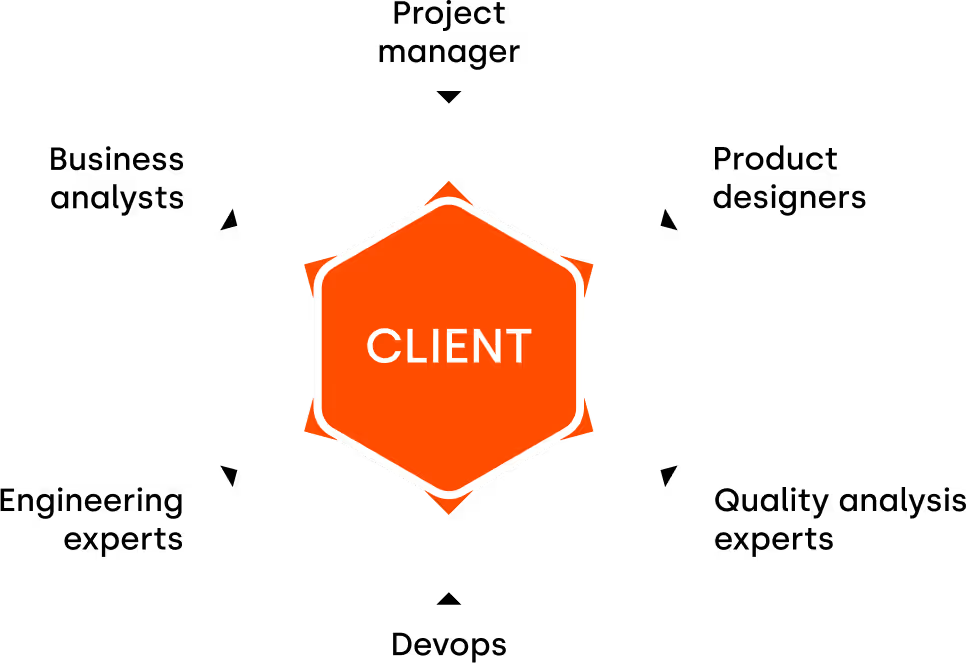
Multidisciplinary team
At Merixstudio, we combine a team-driven approach with measurable outcomes, becoming the go-to partner for businesses seeking to develop tech advantage.
In our collaborative culture, every client and project is treated with utmost respect, ensuring value and consideration are integral to our partnerships.
Analysis outcomes you can expect

Identify and articulate the specific business issues you aim to resolve, providing a solid foundation for solution development and ensuring all efforts are aligned with addressing these key challenges.

Obtain visual representations of your current data and process flows to pinpoint inefficiencies, streamline operations, and facilitate a more comprehensive understanding among stakeholders.

Clarify your product's functionality, ensuring that every feature is purposeful, aligned with user needs, and feasible within your development constraints.

Secure a team composition that aligns our top talent and their skills specifically to your project's needs, ensuring you have the right expertise to bring your vision to life.

Receive realistic estimates of the time, cost, and resources required to complete your project, enabling effective planning and resource allocation.

Get a tailored plan, prepared to meet the unique demands of your project, taking into account your business context, design expectations, and technological requirements
AI-augmented delivery with measurable impact
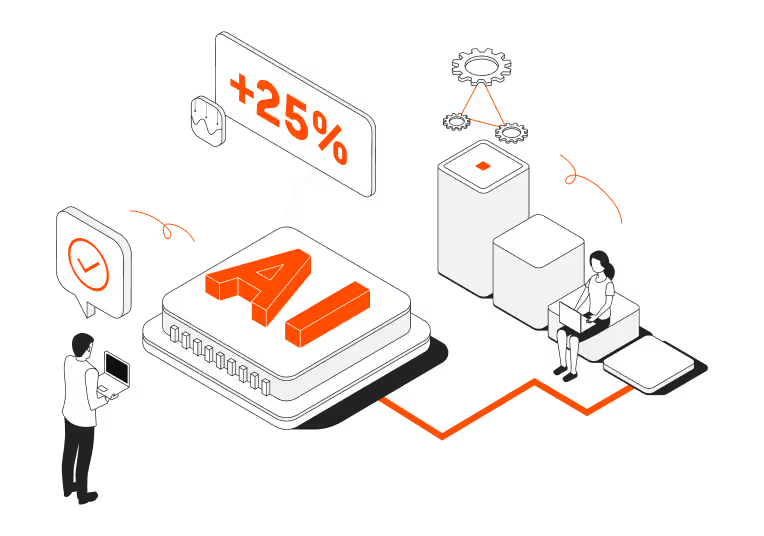
Our teams use AI across day-to-day delivery workflows, from coding and testing to analysis and documentation.
We track its impact through DORA metrics, and on selected tasks it can accelerate delivery by up to 25%.
Bringing the right value
See how scoping has helped our clients improve and move forward faster.

In just two days of workshops, we've done more than we probably did in the last year working on our own. Having the whole team in one room - the architect, the app developers, the UI people, all being able to collaborate at the same time - it really makes a big difference.
The workshop's made me understand my application better than I have in the past 12 years of using it. Being forced to go through and do story mapping, sketches, and discuss specific workflows was very beneficial. That was a big eye-opener.
What Merixstudio has been capable of is basically to look at what we’re saying and understand not what we’re asking for, but what the idea behind what we’re asking for is.


Expert advice for informed strategies



Frequently asked questions
Product discovery is the structured process of validating your product idea, business assumptions, and technical approach before committing to full development. It answers the critical questions that determine whether a project succeeds or fails: are we solving the right problem, for the right users, with the right technology, within a realistic budget and timeline? Without product discovery, teams often build based on assumptions - which leads to scope creep, rework, and products that don't match actual user needs. With it, you enter development with validated requirements, realistic estimates, and a clear roadmap. We've completed over 130 scoping sessions and workshops, and consistently see that teams who invest in discovery build faster, waste less, and ship products that perform better.
Our product discovery services combine business analysis, technical assessment, and user-centered thinking into a structured pre-development engagement. This includes clarifying business goals and defining the core problem to solve, mapping data flows and business processes, defining product functionality scope and feature priorities, validating technical feasibility and recommending architecture, composing the right team for development, producing realistic time and cost estimates, and delivering a bespoke development plan with a clear roadmap. As a software product discovery services provider, we offer three formats depending on your stage: scoping sessions for well-defined products, full product discovery and scoping for ideas that need validation, and custom workshops for projects with many unknowns.
We offer four formats tailored to where you are in your product journey. A scoping recon is a lightweight entry point - a short introductory session where you see how we work, we assess your project context, and you receive a list of unknowns, an initial ballpark estimation, and a recommended plan of next steps. It's designed to lower the barrier to entry and help you decide whether a deeper engagement makes sense. A scoping session (1-2 sessions, 4-6 hours each) is for when you know your product well and need to estimate development costs - we align on objectives, functionality, and the time and effort required for delivery. Product discovery and scoping (3-4 sessions, 4-6 hours each) is for when you need expert validation of your ideas - it saves time and resources by resolving uncertainties early and focusing on products with real demand. A logic-heavy custom workshop (5 days to 2 weeks or more, online or in-person) is for projects with significant unknowns or complex business logic - these extended engagements include deep analysis, event storming, business process mapping, and detailed architecture work, ensuring a smooth transition into development. All formats can be conducted online or in person, and each delivers actionable outputs - not just conversation.
Our product discovery process typically has three stages. First, we align on goals - understanding your business context, target users, and what you're trying to achieve. Second, we analyze - mapping processes, data flows, technical landscape, and user needs through collaborative sessions with your team. Third, we define - producing a clear product scope, feature priorities, architecture recommendations, team composition, realistic estimates, and a development roadmap. A scoping recon takes a single session. A focused scoping session takes 1–2 days. A full product discovery and scoping engagement runs 2–3 weeks. Custom workshops for complex projects typically take 1–2 weeks or more, depending on the number of unknowns and the depth of analysis required. Every format delivers concrete, documented outputs that your team can act on immediately.
Business analysis services focus on understanding how your organization operates, identifying inefficiencies, and translating business needs into software requirements. In our context, business analysis is a core component of product discovery - not a separate engagement. During discovery, our analysts map your business process analysis outcomes: current workflows, data flows, stakeholder needs, and operational constraints. This ensures that the software we recommend isn't just technically sound but actually solves the business problem it's meant to address. The output includes business problem definitions, process flow visualizations, and requirements documentation that serve as the foundation for accurate estimation and effective development.
Every discovery engagement produces documented, actionable outputs - not just presentations or verbal recommendations. Typical deliverables include a business problem definition that clearly articulates what you're solving and why, data and process flow visualizations showing how information moves through your organization, architecture views and ER diagrams mapping the technical landscape, business process maps documenting current and target workflows, a product functionality scope defining what the software needs to do, story maps with MVP definition and development roadmap, team composition recommendations matching skills to project requirements, realistic estimates of time, cost, and resources based on validated scope, and a bespoke development plan with phased priorities. For logic-heavy workshops, deliverables can also include event storming outputs, activity diagrams, and detailed functional component breakdowns. The specific deliverables depend on the format, but all are designed to give you enough clarity to make confident decisions about moving forward.
Product discovery is the most effective way to define what your MVP should include - and equally important, what it should not. MVP development services succeed when the scope is tight, the priorities are clear, and the team isn't building features that won't matter at launch. During discovery, we help you identify the core value proposition of your product, define the minimum set of features that delivers that value, prioritize based on user impact and development effort, eliminate nice-to-haves that increase scope without increasing value, and produce a realistic timeline and budget for the MVP phase. This means your MVP development starts with validated scope rather than assumptions - which is why teams that invest in discovery consistently ship MVPs faster and with fewer pivots.
Requirements gathering is one of the most critical and most frequently mishandled parts of any software project. We approach it as a collaborative process - not a one-way interview. During discovery sessions, we use techniques like story mapping, process flow diagramming, and scenario analysis to surface requirements that stakeholders might not articulate on their own. We distinguish between business requirements (what the organization needs), user requirements (what people actually need to do), and technical requirements (what the system needs to support). The output is a structured requirements document that development teams can work from directly - not a vague wish list. This structured approach to requirements gathering prevents the most common project failure: building the right thing wrong, or the wrong thing right.
To get the most value from discovery, we need access to the people who understand the business problem - product owners, domain experts, decision-makers, or anyone who can explain how things work today and what needs to change. Existing documentation is helpful but not required: product briefs, process diagrams, competitor analysis, user feedback, or technical architecture documents all accelerate the process. If you have none of this, that's fine - discovery is designed to generate it. The most important input is clarity on what's driving the initiative: a new product idea that needs validation, an existing product that needs estimation for development, or a complex project with unresolved questions that need structured answers before you can move forward.
Yes - and this is one of the most valuable outcomes of a discovery engagement. Many organizations start with the assumption that they need custom software, when a configured off-the-shelf tool might serve them better - or vice versa. During discovery, we assess your actual requirements, workflows, and integration needs against what existing solutions can deliver. If off-the-shelf tools cover 80%+ of your needs without major workarounds, we'll tell you. If your processes are unique enough that generic tools would create more problems than they solve, we'll define exactly what custom development needs to cover. This honest assessment saves you from committing to the wrong approach - which is significantly more expensive than the discovery investment itself.
Accurate software project estimation requires understanding scope, complexity, integrations, team composition, and risk factors - none of which can be reliably estimated without structured analysis. During discovery, we break down the product scope into estimable units, assess technical complexity and integration requirements, identify risks and unknowns that could affect timelines, and produce time and cost estimates grounded in validated requirements rather than rough assumptions. Our estimates include ranges (optimistic, expected, pessimistic) rather than single numbers, and we flag assumptions explicitly so you can evaluate the confidence level. This is why discovery consistently delivers more accurate estimates than initial conversations or RFP-based quotes - the underlying analysis is deeper.
Look for a partner that combines technical expertise with business understanding - not just one or the other. A good product discovery workshop facilitator asks hard questions, challenges assumptions, and pushes for clarity rather than agreeing with everything the client says. Check whether they have experience across different types of projects (web, mobile, enterprise, IoT), whether their discovery process produces documented, actionable deliverables (not just meeting notes), and whether the same organization can also take the project through design and development - so context isn't lost in handoff. One of our clients, the CTO of a US-based insurance agency, said our workshop made him understand his own application better than he had in 12 years of using it. That's the level of insight a good discovery partner should deliver.
A discovery phase adds the most value when the cost of getting it wrong is high and the unknowns are significant. This includes new product development where the concept hasn't been validated with real users or technical feasibility, complex enterprise systems with multiple stakeholders, integrations, and competing requirements, legacy modernization where understanding the current state is essential before planning the future state, projects with tight budgets where waste from misaligned scope would be particularly costly, and cross-functional initiatives where business, design, and technology teams need to align before development can start effectively. That said, even well-defined projects benefit from a focused scoping session - the investment is small relative to the cost of discovering misalignment mid-development.
Our discovery and analysis work spans several industries. In logistics, we ran workshops for ParkM that produced more progress in two days than the client had achieved in the previous year working independently - as their CEO described it. In financial services, we helped a US-based insurance agency's CTO understand their own application better than they had in 12 years of using it, through structured story mapping and workflow analysis. In agriculture, we worked with FarmDroid's team to understand not just what they were asking for, but the idea behind what they were asking for - as their Head of After Sales Services put it. In renewable energy, education, smart cities, and manufacturing, our discovery work has consistently been the foundation for successful development engagements. What connects these projects is the shared pattern: complex business contexts where investing in structured understanding before development makes the difference between a successful product and an expensive miss.
Discovery and analysis generate large volumes of information - stakeholder input, process documentation, competitive analysis, user research data, and workshop outputs. AI-augmented delivery helps process and synthesize this faster, so our analysts and product specialists spend more time on insight and strategic recommendations and less on manual documentation and organization.
In practice, AI assists with summarizing and organizing workshop outputs and meeting transcripts, analyzing business processes and identifying patterns across documentation, prioritizing feature lists and mapping dependencies, generating initial process flow visualizations and data models, and producing structured requirements documentation from unstructured inputs. To keep AI disciplined, we follow Spec Driven Development: every feature specification and requirement produced during discovery is validated by senior analysts before it becomes part of the development roadmap.
We measure the delivery impact through DORA metrics, giving clients visibility into how AI supports faster, more reliable delivery. Based on feedback from our entire engineering team, AI can accelerate selected tasks by up to 25%. Every AI tool is vetted by our technical and legal teams, 94% of team members confirmed awareness of data security rules for AI usage, and no project data is ever used to train external models.
.svg)
.svg)
.svg)
.avif)

.avif)
.avif)
.avif)
