Product Design Services

From discovery workshops and UX research to UI design and design systems - products users love, businesses profit from.

Let's talk

Product design services: from requirements to final vision of your product

Good product design isn't decoration - it's the difference between software people adopt and software they abandon. We combine UX research, interface design, and prototyping to make sure what gets built is what your users actually need and your business can sustain.

Our design process is AI-augmented at every stage - from rapid concept generation and AI-assisted ideation to prototyping interfaces that incorporate conversational UI, predictive UX, and personalization patterns. This doesn't replace design thinking; it compresses the path from insight to testable prototype, so decisions happen faster and are grounded in data, not assumptions.

Whether you're launching a new product, redesigning an existing one, or building a design system that scales across teams - our product designers work embedded with engineers and business stakeholders, not in a silo.

Improved user experience

Design grounded in research and testing - not assumptions. Fewer friction points, higher adoption.

Stronger brand recognition

Design systems and UI standards that scale across your product without visual drift.

Increased sales

Interfaces optimized for the actions that drive your revenue -  tested before development starts.

Reduced costs

Validated prototypes catch problems at the design stage, not after 3 sprints of coding.

Faster time to market

Clickable prototypes and design sprints compress the path from idea to first usable version.

Optimized delivery

Structured handoff with specs, tokens, and component logic -  no guesswork in implementation.

Designs that make
a difference

Our product design process

Five stages from understanding your users to a tested, development-ready design - each grounded in research, not guesswork.

01

Empathize

To create solutions that truly help people, we need to understand their needs, motivations, and what they struggle with.

By listening to them carefully, we can identify the gaps between their current experiences and the ideal solutions they desire. This understanding is
the foundation for designing solutions that make
a difference.

user research
user Interviews
needs discovery
Customer journey map
02

Define

After understanding users' needs and challenges, we clearly define the problem we want to solve.

We gather key insights, create user profiles,
and summarize the problem so it's easy to understand and address. This helps us focus on creating solutions that truly make a difference for users.

data gathering
Customer Insights
target user personas
problem & opportunity
definition
03

Ideate

The ideation phase is where the team lets their creativity flow to come up with solutions to the problem.

We brainstorm and clash ideas, we push the boundaries, and explore unconventional approaches. The goal is to gather a variety of potential solutions from which the best ones can be chosen and developed further.

storyboards
Concept sketches
Moodboards
user flows
04

Prototype

Next, we turn our ideas into tangible representations to test them and get feedback from users. 


We create a close representation of the product without jumping into code. We iterate on it to make better design decisions and get the product right before we spend a lot of time and money on development.

interactive prototypes
animations
Hi-fidelity designs
iterative design
05

Test

The testing phase is where we test our prototypes with users to see how they work and give feedback.

We do this to make sure the product is easy to use and that we've addressed the users' needs. The testing process is iterative, with us continuously testing and refining the product until it's ready.

usability testing
A/b testing
research reports
improvement recommendations

What sets our product design apart

Research-driven, business-aware, and built for real implementation - not just aesthetics. Every design decision we make is grounded in user data and aligned with your engineering reality, so what we deliver is ready to build,
not just ready to present.

Person with blonde hair studies a whiteboard covered in colorful sticky notes and project labels.

We create through a deep understanding of the user and business - the needs and the pain points seen from both sides.

Woman in a pink sweatshirt with roosters drawing or writing on paper at a table.

We identify and characterize the target user groups, understand their demographics, behaviors, preferences, and needs for tailored and engaging solutions.

Person arranging colorful sticky notes and printed sheets on green carpet for product design planning.

We translate insights into actionable recommendations that address the identified problems and enhance the user experience. We provide clear and concise guidance to stakeholders, outlining specific design challenges and improvements that will drive positive outcomes.

Collection of mobile app screens showing user profile, login, congratulations, and task completion in blue and white theme.

We craft intuitive, aesthetically pleasing, and functional web and mobile experiences, ensuring seamless interaction and user satisfaction.

Person sketching charts and app designs on paper, surrounded by design thinking and UX planning sheets.

We can establish a visual identity or expand on your existing one. Designs we create align with the overall brand identity, ensuring that all aspects of the product reflect your values for a cohesive and consistent experience across all touch points.

Man wearing glasses pointing at a transparent board while holding a smartphone in an office.

We craft experiences that are not only functional but also engaging, memorable, and enjoyable. Our designs not only satisfy user needs but also exceed expectations, drive engagement and loyalty, and set up a positive brand perception.

Two people writing on a glass wall with colorful sticky notes in a bright office space.

We engage and collaborate closely with you and other teams across disciplines to facilitate open communication and knowledge sharing. We always make sure that all stakeholders are aligned on the design vision and objectives.

AI-augmented delivery with measurable impact

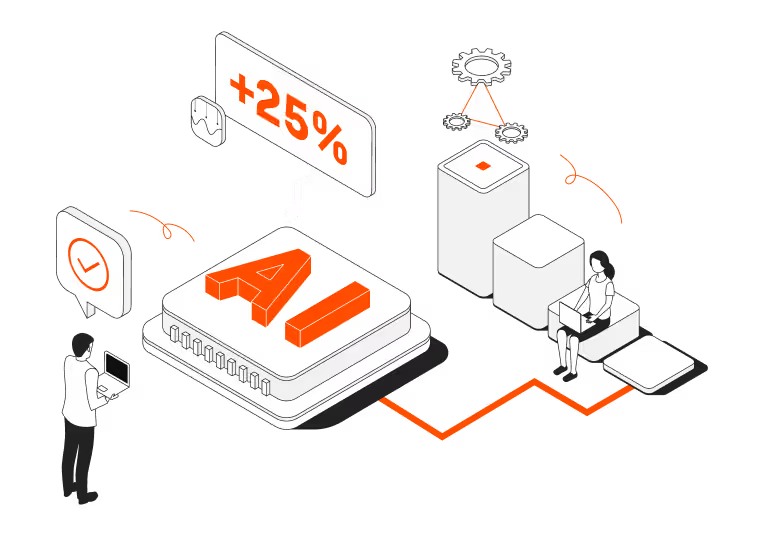
Our teams use AI across day-to-day delivery workflows, from coding and testing to analysis and documentation.
We track its impact through DORA metrics, and on selected tasks it can accelerate delivery by up to 25%.

See how we integrate AI into our process
Illustration of AI chip with +25% efficiency, two people using laptops and gears symbolizing technology.

Design that's ready to build. Let's start with your product.

Let's talk

Frequently asked questions

Product design services cover the full process of transforming business goals and user needs into well-designed, functional digital products. This includes user research, problem definition, ideation, wireframing, high-fidelity UI design, interactive prototyping, and usability testing - all before development begins. Unlike visual design alone, product design services address the entire user experience: how people discover, learn, use, and get value from your product. The goal is a product that's not only visually polished but also intuitive, enjoyable to use, and aligned with measurable business outcomes.

Our ux design services span the full design lifecycle - from understanding users to delivering tested, development-ready designs. This includes user research (interviews, surveys, needs discovery), customer journey mapping to identify pain points and opportunities, user persona development and problem definition, information architecture and user flow design, wireframing and interaction design, high-fidelity UI design for web and mobile, interactive prototyping for stakeholder review and user testing, and usability testing with real users to validate decisions before development. As a user experience design services provider, we treat design as a problem-solving discipline - not just an aesthetic exercise.

Our ui ux design services combine visual design with experience strategy. On the UX side, we research user needs, map journeys, define problems, and design interactions that make complex products feel simple. On the UI side, we craft pixel-perfect interfaces, establish or extend design systems, create responsive layouts for web and mobile, and ensure visual consistency across all touchpoints. We also offer ui ux design and development services - meaning we don't hand off static mockups and walk away. Our design team works alongside our engineering team, so designs are built exactly as intended, with the technical constraints understood from the start.

Product design is the broader discipline - it encompasses UX design but also includes business strategy, market positioning, feature prioritization, and the connection between design decisions and business outcomes. UX design focuses specifically on how users experience and interact with the product - navigation, flows, usability, accessibility. In practice, when we deliver product design vs ux design as a service, product design engagements tend to start earlier (before features are defined) and cover more strategic ground, while UX design engagements often start with an existing product that needs improvement. We offer both, and the right scope depends on where you are in your product lifecycle.

Our product design process follows five phases. Empathize - we conduct user research, interviews, and needs discovery to understand who your users are and what they struggle with. Define - we gather insights, create user personas, and clearly articulate the problem we're solving. Ideate - we brainstorm, sketch concepts, create storyboards and user flows, and explore multiple directions before narrowing down. AI assists in this phase by generating initial layout concepts and multiple variants that designers evaluate and refine - accelerating exploration without replacing creative judgment. Prototype - we turn the best ideas into interactive, high-fidelity prototypes that look and feel like the real product. Test - we validate prototypes with real users through usability testing, gather feedback, and iterate until the design is ready for development. This process is iterative, not linear - we go back and refine based on what we learn at each stage.

Yes - a ux audit is one of our most requested design services, especially for products that already exist but aren't performing as expected. We evaluate your product from the user's perspective: analyzing navigation, task flows, information architecture, visual hierarchy, accessibility, and overall usability. The audit includes heuristic evaluation against established usability principles, analysis of user behavior data (if available), identification of friction points and drop-off patterns, and a prioritized list of improvement recommendations with expected impact. A UX audit is particularly valuable before a redesign or modernization - it gives you a clear, evidence-based picture of what's working and what needs to change, so design effort is focused where it matters most.

Yes - usability testing is a core part of our design process, not an optional add-on. Our usability testing services include moderated and unmoderated testing sessions with real users, task-based testing to measure how easily users complete key actions, A/B testing to compare design alternatives, and detailed research reports with actionable improvement recommendations. We test prototypes before development to catch issues early (when they're cheapest to fix), and we test live products to identify improvement opportunities. Testing with real users - not just stakeholders - is what separates design assumptions from validated design decisions.

Yes - prototyping is a critical phase in our design process. Our prototyping services deliver interactive, clickable prototypes that look and behave like the final product - without the cost and time of actual development. We use prototypes to test design concepts with real users before committing to code, align stakeholders around a shared vision of the product, identify usability issues and iterate before they become expensive development rework, and present a tangible product vision to investors, board members, or internal decision-makers. Our designers use AI-assisted tools to generate multiple UI variants quickly - accelerating the exploration of different approaches - while maintaining full creative control over the final prototype. Prototypes range from low-fidelity wireframes for early concept validation to high-fidelity, pixel-perfect interactive designs that are ready for developer handoff.

Yes - we design for web, mobile, and cross-platform products. Our mobile app design services cover iOS and Android, including platform-specific design patterns, touch-optimized interactions, and responsive layouts. Our web app design services cover everything from complex enterprise dashboards and SaaS platforms to customer portals and internal tools. We also design for products that span both - ensuring visual consistency, shared design language, and a coherent experience across platforms. For data-heavy products, our dashboard design services focus on making complex information clear and actionable through thoughtful visualization, hierarchy, and role-based views.

The starting point depends on your stage. If you have existing user research, product requirements, or a design brief, we can move quickly into ideation and design. If you're earlier - with an idea but no validated requirements - we start with a research and discovery phase to understand your users, market, and business goals. In either case, it helps to have clarity on who your target users are (or who you think they are), what problem the product solves, any existing product, wireframes, or design assets we can build on, and your timeline, budget, and any technical constraints. The most important input is access to real users or user data - design decisions validated by actual user behavior are always stronger than decisions based on stakeholder assumptions.

Yes - and we do this regularly. Whether you need to augment your team with additional UX researchers, UI designers, or product designers, we embed experienced professionals into your workflow. If you're looking to hire ux designers for a specific project or ongoing product development, our team augmentation model provides designers who integrate with your existing tools, processes, and communication patterns. We also work closely with development teams - our designers understand technical constraints and design with implementation in mind, so handoff is seamless and the final product matches the design intent.

When choosing a ux consulting partner, look for a team that leads with research, not aesthetics. A strong UX partner starts by understanding your users and your business context before opening a design tool. Ask whether they conduct real user research (not just desk research or stakeholder interviews), whether they test designs with real users before handoff, and whether they can connect design decisions to measurable business outcomes. Check for experience across different product types - dashboards, portals, mobile apps, enterprise tools - not just marketing websites. It's also important that the design partner can work with your development team, not in isolation. Designs that don't account for technical constraints rarely survive implementation intact.

This is one of our key differentiators. Unlike standalone design agencies, our product design and development capabilities live under one roof. The same organization that researches, designs, and prototypes your product can also build and maintain it. This means designers and engineers collaborate from the start - technical feasibility is considered during design, not discovered during handoff. Design systems and component libraries are built to be developer-friendly. Prototypes are created with real data structures and interaction patterns in mind. And there's no re-briefing a separate development team on what was designed and why. The result is a faster path from validated design to working product, with fewer surprises along the way.

Our product design work spans several industries. In precision agriculture, we designed the mobile interface for FarmDroid's autonomous field robot - combining complex operational workflows with an intuitive experience for users ranging from engineers to farmers (featured on Behance). In renewable energy, we designed a solar comparison portal for Selfmade Energy and energy management applications for Solar Power Group. In education, we designed Kaiik'ìt - a mobile app for learning Gwich'in, an indigenous language, where cultural sensitivity and intuitive mobile design were equally important. In smart cities, we shaped the experience for Expo City Dubai's mobile super app - a project that earned second prize at the WaysConf 2024 Awards in the mobile category. What connects these projects is the shared challenge of making complex, data-rich, or specialized products feel accessible and intuitive to their target users.

AI is embedded across every phase of our design process - not as a replacement for design thinking, but as an accelerator that lets designers focus on creative decisions and user empathy rather than repetitive tasks.

In research and workshops, AI helps organize and summarize client materials, generate workshop frameworks, prioritize large volumes of ideas, and analyze qualitative and quantitative research data - identifying patterns, trends, and insights across interview transcripts and survey results faster than manual analysis. In UX/UI design, our team uses AI tools including Figma AI, Figma Make, and UX Pilot to accelerate ideation - generating initial layout concepts, producing multiple UI variants for evaluation, and preparing first sketches that designers then refine and develop further. AI also supports accessibility by analyzing color contrast, generating alt text for images, and checking content against plain language standards. For interface content, AI assists with microcopy generation, text variants for different tones, and translation - always with human review of the final output.

The key constraint we maintain: AI generates starting points, not final designs. AI-produced UI variants can look polished but often lack the full product context, user research grounding, and brand sensitivity that a human designer brings. The designer's role shifts from producing every pixel to curating, evaluating, and refining - which is a more efficient use of their expertise.

To keep this disciplined across design and development, we follow Spec Driven Development: every feature starts with validated specifications before implementation. We measure the delivery impact through DORA metrics, giving clients visibility into how AI supports faster, more reliable delivery. Based on feedback from our entire engineering team, AI can accelerate selected tasks by up to 25%. Every AI tool is vetted by our technical and legal teams, 94% of team members confirmed awareness of data security rules for AI usage, and no project data is ever used to train external models.