.svg)


Python Development Services
Django, FastAPI & Flask backends for products that handle real data, real traffic, and real complexity.





Python development capabilities
We use Python to build backend systems for data-intensive applications: APIs powering SaaS platforms, automation pipelines replacing manual workflows, and backend services processing high-volume data in real time. Our stack centers on Django for complex web applications, FastAPI for high-performance microservices, and Flask for lightweight, focused services.
Our Python engineers work within an AI-augmented delivery model: AI-assisted code generation, automated test coverage, and specification-driven development that cuts delivery time without cutting corners.
From a medical board platform processing thousands of cases to solar energy calculation engines generating instant customer quotes, our Python backends run where accuracy and uptime matter most.
Ensure high scalability
Handle growing data volumes and concurrent users with Python's async capabilities and cloud-native deployment patterns.
Accelerate delivery
Django's batteries-included approach and FastAPI's auto-generated docs mean less boilerplate, more business logic.
Harness versatile application
Backend APIs, data processing, automation scripts, ML pipelines - Python covers the entire backend spectrum without language-switching overhead.
Boost efficiency
200,000+ PyPI packages, second-largest GitHub community, and mature tooling for testing, monitoring, and deployment.
How we help

Rapid development and deployment are at the heart
of creating dynamic web applications using Python. Clients benefit from scalable, secure,
high-performance solutions, with Python's simplicity and vast libraries tailoring these applications
to specific needs.

Designing and developing bespoke software solutions with Python uniquely caters to specific business processes and needs. Businesses experience high adaptability, efficient integration,
and a performance-focused approach, leveraging Python's versatility.

Augmenting a client's team with skilled Python developers accelerates project timelines, enhances development quality, and brings specialized Python expertise. This approach is ideal for projects requiring additional manpower or specific Python skills.

Transitioning from Python 2 to Python 3 is streamlined with comprehensive application analysis. Clients enjoy enhanced security, improved performance, and access to the latest Python features and libraries.

Transitioning software systems to Python from other programming languages enhances maintainability, scalability, and efficiency. Businesses leverage Python’s simplicity, extensive libraries, and robust community support.

Transforming monolithic applications into microservices architectures using Python enhances scalability, eases maintenance, and improves fault isolation. Ideal for businesses to modernize their infrastructure for better agility and performance.

Seamless connectivity with external systems is achieved by integrating Python applications
with third-party services and APIs. This expansion enhances application functionality and user experience, which is vital for broadening capabilities.

Developing RESTful APIs and GraphQL applications
with Python enables efficient and flexible data handling. This approach is crucial for building scalable web services and applications interacting with diverse clients and services.

Creating powerful search engines for applications using technologies like ElasticSearch, Solr, or Algolia provides fast, accurate, and scalable search functionalities. Python's capabilities enhance user experience in applications.
Refined solutions bringing the right value
See how we improve customer engagement, back office experience, and overall business processes.

From Excel to an advanced proposal tool
The development of a web-based solar modeling and proposal tool enhancing sales efficiency and customer engagement.


The transition to web application was overall smooth and did not result in a loss of sales productivity. As a matter of fact, we broke the sales record in the very month of the application launch!
Explore the stories of our clients
View all case studies


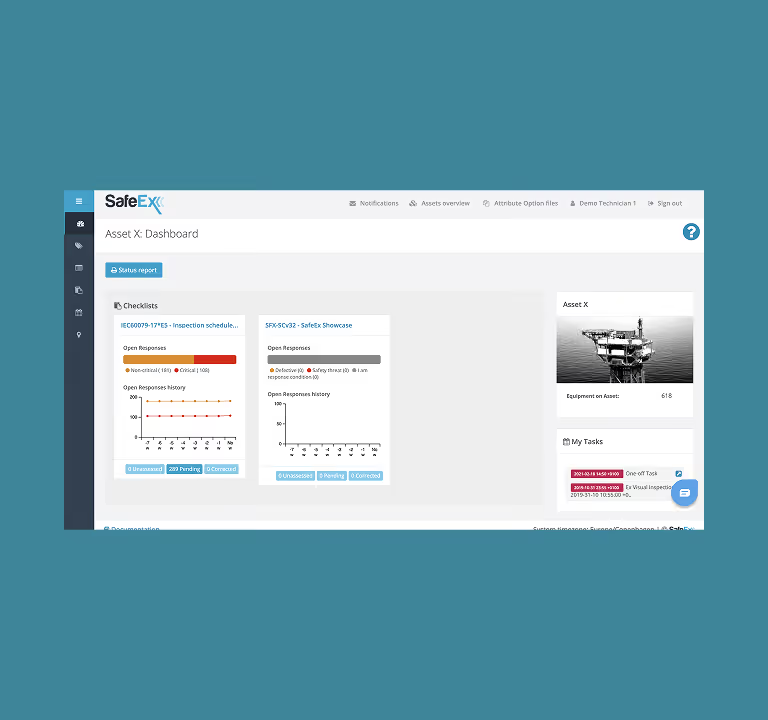

Learn from our clients how to hire the right developers


Understand before building
Our workshops are custom-fit to meet our clients' unique needs, ensuring we grasp all requirements right from the start. Valued
by our clients for refining their ideas and by our teams as the most effective kickoff for projects, these sessions establish
a unified understanding from day one.

Scoping session
If you are well-versed with your product and need to estimate development costs, consider
a scoping session.
This collaborative process aims
to align all team members
on the project's objectives, functionalities, and the necessary time and effort for successful delivery.
1-2 online or indoor sessions
(4-6h per session)

Product discovery & scoping
If you are looking for expert validation of your ideas to ensure your products meet real needs, consider product discovery & scoping.
It saves time and resources
by resolving uncertainties early
and concentrating on products
with true demand.
3-4 online or indoor sessions
(4-6h per session)

Logic heavy custom workshop
If you are working on a project
with many unknowns, consider custom workshops.
It's structured to address and resolve pressing concerns, ensuring
a seamless transition into
the development phase.
1-2 online or indoor sessions
(4-6h per session)
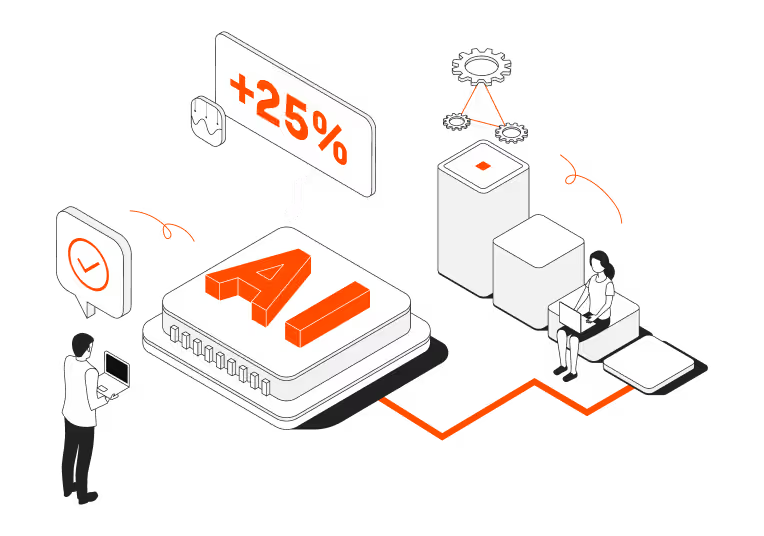
AI-augmented delivery with measurable impact
Our teams use AI across day-to-day delivery workflows, from coding and testing to analysis and documentation.
We track its impact through DORA metrics, and on selected tasks it can accelerate delivery by up to 25%.
Customer satisfaction speaks for itself
Our expertise lies in striking the balance between high performance, impeccable mobile design, scalability, and cutting-edge innovation, whether through native or cross-platform solutions.
Expert advice for informed strategies




Frequently asked questions
Python development services cover the full range of backend engineering, API development, and custom software development using Python and its ecosystem of frameworks - primarily Django and FastAPI. This includes building web applications, REST APIs and GraphQL endpoints, data processing pipelines, integration layers connecting internal and external systems, and migration of existing applications to Python from other languages or from older Python versions. Python's simplicity, extensive standard library, and strong community make it one of the most versatile languages for backend development - which is why it's our primary backend technology for custom web and enterprise applications.
We use Python across a wide range of application types: custom web applications with complex business logic, SaaS platforms requiring multi-tenancy and scalable architecture, data-heavy dashboards and reporting interfaces, backend systems for mobile and IoT products, API layers connecting multiple systems and services, and internal tools for process automation and workflow management. As a python software development company, we focus on applications where backend complexity, data processing, and integration depth matter more than basic CRUD operations - that's where Python's strengths create the most value.
Both Python and Node.js are mature, widely used backend technologies - and choosing between them depends on your project's priorities. Python is typically the stronger choice when your application involves complex business logic, data processing, or analytics (Python's ecosystem for data is unmatched), when you need rapid development with clean, maintainable code (Python's readability reduces onboarding time and long-term maintenance costs), when your team needs to integrate with scientific or machine learning libraries, or when the backend will grow in complexity over time and code clarity matters more than raw throughput. Node.js can be a better fit for applications that are primarily I/O-bound with lightweight business logic, or when your entire stack is JavaScript and you want a unified language across frontend and backend. In our experience, most enterprise and mid-complexity web applications benefit more from Python's clarity, framework maturity (Django, FastAPI), and ecosystem depth - which is why it's our primary backend language.
Django and FastAPI are both Python web frameworks, but they serve different use cases. Django is a full-featured framework with a built-in ORM, admin panel, authentication, and a rich ecosystem of packages. It's our go-to for applications with complex data models, content management needs, and multi-feature web platforms where development speed and convention-over-configuration matter. As a django development company, we use Django for the majority of our enterprise and mid-complexity web applications. FastAPI is a modern, high-performance framework built for APIs and microservices. It offers native async support, automatic OpenAPI documentation, and significantly faster request handling than Django for API-heavy workloads. We use FastAPI when the project is primarily an API layer, a microservice, or a data processing backend where performance and throughput are critical. In some projects, we use both: Django for the main application and FastAPI for specific high-performance services.
Yes - Django is one of our primary Python frameworks and we have deep experience building web applications, portals, APIs, and enterprise systems with it. Our django development services include architecture design and database modeling, full-stack web application development, REST API and GraphQL endpoint development, admin panel customization and extension, third-party integrations and payment processing, performance optimization and query tuning, and migration from legacy systems or other frameworks to Django. As a python django development company, we select Django when the project benefits from its batteries-included approach - a rich ORM, built-in auth, admin interface, and a mature ecosystem that accelerates development without sacrificing flexibility.
If you're looking to hire python developers or hire django developers for a specific project - or extend your existing team with Python backend expertise - we offer a team augmentation model that embeds experienced engineers directly into your organization. Our Python developers bring deep knowledge of Django, FastAPI, PostgreSQL, REST and GraphQL APIs, containerized deployments, and modern Python development patterns. We define collaboration patterns and communication protocols upfront so the augmented team operates as a seamless extension of yours. This model works well when you have product ownership in-house but need additional Python backend capacity or specialized Django expertise to accelerate delivery.
Yes - migration to Python is one of our core services. We work with organizations that want to move from languages like PHP, Ruby, or Java to Python for better maintainability, a richer ecosystem, or access to Python's data and AI libraries. We also handle migrations from older Python versions - Python 2 reached end of life in 2020, and organizations still running Python 2 codebases face growing security risks, library incompatibility, and inability to hire developers willing to work with unsupported technology. Our migration process starts with a thorough analysis of your current application - architecture, dependencies, data models, integrations, and business logic - before we define a migration strategy. We plan migrations to minimize business disruption: typically migrating in stages, running systems in parallel, or rebuilding specific services while keeping others operational. The goal is a cleaner, more maintainable codebase on a current, supported Python version without losing functionality or forcing users through a disruptive transition.
Every engagement starts with understanding your product and business context before writing code. Depending on your stage, this can mean a scoping session (if you know what you need and want to estimate costs), a product discovery and scoping engagement (if you need expert validation of your ideas), or a custom workshop for projects with many unknowns. From there, we move into architecture design, development, and iterative delivery - with regular reviews and quality assurance throughout. Our Python development process includes CI/CD automation, automated testing, security scanning, and ongoing performance monitoring. On the engineering side, our teams work within an AI-augmented delivery model, following Spec Driven Development practices and tracking delivery performance through DORA metrics.
Timelines depend on scope and complexity. A focused Python backend MVP - core API, database, basic integrations - can typically be delivered in 6–10 weeks. Mid-complexity applications with custom business logic, multiple integrations, and data processing layers usually take 3–6 months. Large-scale enterprise backends with complex data models, high-throughput APIs, and extensive system integrations can take 6–12 months, delivered in phases. We provide precise timeline and cost estimates after the scoping or discovery phase, so you have a clear picture before committing to development.
When choosing a python web development company, look for a partner that goes beyond framework expertise. A good Python development partner understands backend architecture at scale - not just how to write Django views. Ask about their experience with API design (REST, GraphQL), database optimization (PostgreSQL query tuning, indexing strategies), and how they handle integration with existing systems. Check whether they offer the full lifecycle: discovery, architecture, development, testing, and post-launch support. A strong Python partner also brings product thinking - helping you scope features, prioritize, and plan iterations. It's also worth asking how they ensure code quality - partners who follow specification-driven practices and measure delivery through frameworks like DORA are typically operating at a higher level of engineering maturity.
We build Python APIs using Django REST Framework for full-featured web APIs and FastAPI for high-performance, async API endpoints. For microservices architecture, we design each service around a bounded domain context with clear API contracts, independent deployability, and well-defined data ownership. Our python api development approach includes OpenAPI specification and automatic documentation, authentication and authorization (OAuth2, JWT), rate limiting and request validation, integration with message queues and event-driven architectures where needed, and containerized deployment using Docker and Kubernetes. We design APIs and microservices to be testable, observable, and maintainable - not just functional.
Our Python backend work spans several industries. In renewable energy, we built a custom solar modeling and proposal tool for Boston Solar that shortened their sales cycle time by 33% - the client broke their sales record the month the application launched. In education, we developed a recital scheduling platform for Juilliard School that drove a 25% increase in ticket sales through advanced booking workflows. In SaaS, we supported the scaling of Divio's enterprise Django content management system - a project where deep Django expertise was essential. In finance, we modernized the backend for Facta's financial data platform, enabling 80% less work to close the month. In sports technology, we built data-processing backends for Biocore that made impact data analysis 4x faster through advanced visualizations. And in manufacturing, we developed a backend-heavy system for RP Group to manage emergency and safety lighting infrastructure. What connects these projects is the shared need for reliable, scalable Python backends that handle complex business logic and data processing.
Python handles the backend layer within a broader product architecture. In our typical stack, the frontend is built in React or Next.js, the mobile layer in Flutter, and the backend in Python (Django or FastAPI) - all connected through REST or GraphQL APIs. Python backends integrate with PostgreSQL for data storage, AWS for cloud infrastructure, Docker and Kubernetes for containerized deployment, and Terraform for infrastructure-as-code. If you already have a frontend application or mobile app, our Python backend work fits alongside it - we don't need to rebuild your existing stack. This modular approach means each layer can evolve independently as your product grows.
Python development involves repetitive patterns - API endpoint scaffolding, model definitions, serializer boilerplate, test coverage, and documentation. AI-augmented delivery targets exactly these areas, freeing engineers to focus on business logic, data modeling, and architectural decisions that are unique to your project.
To keep AI output consistent with your project's architecture and conventions, we follow Spec Driven Development: every feature starts with a validated specification and acceptance criteria before implementation. Engineers review every AI-generated model, endpoint, and test against the spec - so the backend behaves exactly as defined.
We measure the impact through DORA metrics, giving clients clear visibility into how AI supports faster delivery, fewer bugs, and shorter feedback loops. Based on feedback from our entire engineering team, AI can accelerate selected tasks such as code generation, debugging, refactoring, and test automation by up to 25%.
Every AI tool we use is vetted by our technical and legal teams and governed by clear internal security policies. In our latest internal survey, 94% of team members confirmed awareness of data security rules for AI usage, and no project data is ever used to train external models.
.svg)
.svg)
.svg)
.avif)

.avif)
.avif)
.avif)
