.svg)


React Development Services
Build fast, scalable web apps and SPAs with engineers who've shipped React across enterprise, SaaS, and IoT projects.





React development capabilities
We use React to build complex single-page applications, enterprise dashboards, SaaS platforms, and customer-facing portals - software that needs to be fast, maintainable, and scalable from day one.
Whether you're building a new frontend from scratch, modernizing a legacy UI, or migrating to Next.js for server-side rendering and better performance, our frontend engineers bring 25+ years of delivery experience to every engagement.
Our React development services follow an AI-augmented delivery model: AI-assisted code generation, automated testing, and specification-driven workflows that shorten development cycles without sacrificing code quality. This approach has delivered results across projects ranging from real-time data dashboards for sports biomechanics to scheduling platforms handling thousands of concurrent users.
Accelerate development speed
Reusable component libraries and AI-assisted code generation cut frontend development time by up to 30%.
Enhance user experience
Declarative, component-based architecture delivering sub-second interactions and smooth state management.
Boost productivity
Hot reloading, mature tooling ecosystem, and established patterns - your team ships from day one.
Ensure stability
Backward-compatible framework backed by Meta, with the largest frontend community and long-term support.
How we help
React ensures a quick feature delivery and leaves room
for adjustments along the way, we embrace its capabilities
in both startup and more mature projects. Now you can make
it the frontend backbone of your software.

Embracing React for MVP development fosters
an environment of agility and adaptability. This method ensures that the core features of a product are brought to light efficiently, facilitating rapid testing and feedback.
It paves the way for potential pivots without extensive overhauls, optimizing time to market and aligning
the product closely with user needs for a stronger market fit.

Scaling MVPs to the enterprise level with React bridges the gap between an early-stage product and a robust, market-ready application. This elevation strengthens the product's initial framework, enhancing its capability to support larger user bases and complex functionalities.
Businesses gain an advanced product that not only meets industry standards but is also scalable
and resilient.

Designing with React lays the groundwork for a solid, maintainable code architecture, capable of adapting to the evolving tech landscape.
This strategic structuring supports a clear and modular framework, simplifying future enhancements. It ensures the application remains agile and robust, promoting its longevity and adaptability.

Our expertise in the React ecosystem extends beyond application development - we equip the client's team with the knowledge and best practices needed to stay at the forefront of innovation.
Through this transfer of insights, the in-house team will be poised to maintain excellence, leveraging the full spectrum of React's capabilities to drive the product forward.

Maintenance and refactoring of React solutions
Optimized data handling
with React state management
React codebase evaluation and enhancement

Ensuring the health and efficiency of a React application is pivotal for its longevity. Our maintenance and refactoring services are designed to enhance code readability, streamline functionality, and reduce technical debt.
This process leads to a more efficient, clean, modern application, consistently delivering peak performance and an exceptional user experience.

Implementing state management solutions within
the React framework provides a structured approach to data flow, ensuring data integrity and consistency across the application.
This strategic implementation fosters a responsive
and scalable environment, crucial for the seamless operation and growth of the application as user demands evolve.

Analyzing and refining the current React codebase is critical for ongoing application health. This thorough examination uncovers optimization opportunities, paving the way for targeted enhancements that boost performance and user engagement.
Continuous codebase optimization ensures that your React application remains ahead, delivering
a seamless and dynamic user experience.
Refined solutions bringing the right value
See how we improve customer engagement, back office experience, and overall business processes.

Digital solutions for the agricultural robot
Making modern farming easier and more intuitive with web and mobile platforms for managing the first solar-powered autonomous field droid.


What Merixstudio has been capable of is basically to look at what we’re saying and understand not what we’re asking for, but what the idea behind what we’re asking for is.
Explore the stories of our clients
View all case studies


Learn from our clients how to hire the right developers


Understand before building
Our workshops are custom-fit to meet our clients' unique needs, ensuring we grasp all requirements right from the start. Valued by our clients for refining their ideas and by our teams as the most effective kickoff for projects, these sessions establish a unified understanding from day one.

Scoping session
If you are well-versed with your product and need to estimate development costs, consider
a scoping session.
This collaborative process aims
to align all team members
on the project's objectives, functionalities, and the necessary
time and effort for successful delivery.
1-2 online or indoor sessions
(4-6h per session)

Product discovery & scoping
If you are looking for expert validation of your ideas to ensure your products meet real needs, consider product discovery & scoping.
It saves time and resources
by resolving uncertainties early
and concentrating on products
with true demand.
3-4 online or indoor sessions
(4-6h per session)

Logic heavy custom workshop
If you are working on a project
with many unknowns, consider custom workshops.
It's structured to address and resolve pressing concerns, ensuring
a seamless transition into
the development phase.
1-2 online or indoor sessions
(4-6h per session)
AI-augmented delivery with measurable impact
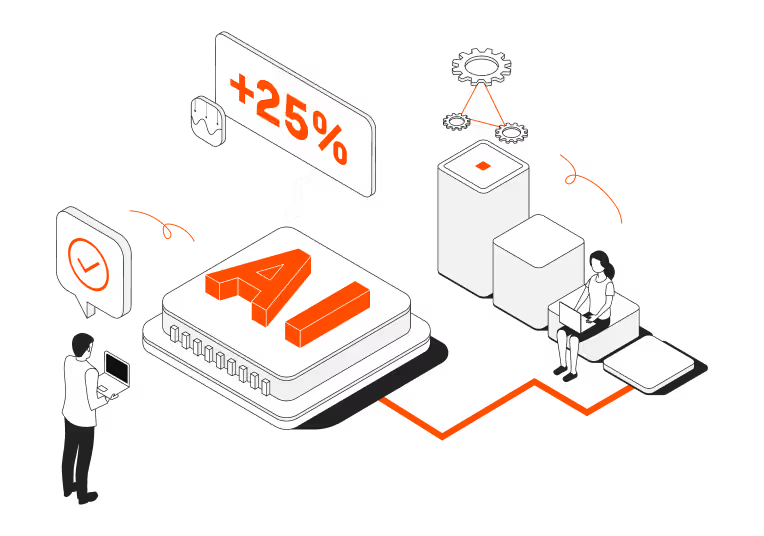
Our teams use AI across day-to-day delivery workflows, from coding and testing to analysis and documentation.
We track its impact through DORA metrics, and on selected tasks it can accelerate delivery by up to 25%.
Customer satisfaction speaks
for itself
Expert advice for informed strategies


Frequently asked questions
React development services cover the full process of building dynamic, high-performance web applications using React and its ecosystem. This includes component architecture design, state management implementation, responsive UI development, API integration, performance optimization, and ongoing maintenance. React's component-based architecture enables reusable, testable code that scales well as applications grow in complexity. Combined with Next.js for server-side rendering and static generation, our react development services deliver web applications that are fast, SEO-friendly, and built for long-term maintainability.
We use React across a wide range of web application types: data-rich dashboards and business intelligence interfaces, customer-facing portals and platforms, SaaS applications with complex UI requirements, single page applications for fast, fluid user experiences, enterprise web applications with multiple user roles and deep integrations, and internal tools for operational workflows and process management. As a react js development company, we focus on applications where frontend complexity, interactivity, and user experience are critical to business success - not just static content sites that could be handled by simpler tools.
React is a JavaScript library for building user interfaces - it handles the component layer but leaves decisions about routing, data fetching, and rendering strategy to the developer. Next.js is a framework built on top of React that adds server-side rendering (SSR), static site generation (SSG), API routes, and file-based routing out of the box. We use React on its own when the application is a pure single page application (SPA) that doesn't need SEO optimization or server-side rendering - typically internal tools, dashboards, and admin panels. We use Next.js when the application needs fast initial load times, strong SEO performance, or hybrid rendering strategies - typically customer-facing platforms, marketing-connected applications, and products where page speed directly impacts conversion. Our next.js development services cover the full range of SSR, SSG, and hybrid applications. As a next.js development company, we select the right approach based on your product requirements, not framework preference.
Both React and Angular are mature, widely adopted frontend technologies - and the choice depends on your project's needs and team context. React offers a more flexible, component-based approach with a lighter core - you choose your own routing, state management, and build tooling. This makes React highly adaptable and easier to integrate into existing architectures. Angular is a full-featured framework with opinionated structure, built-in dependency injection, and a comprehensive CLI - which can accelerate development for teams that prefer convention over configuration. In our experience, React is the stronger choice for most custom web applications: its ecosystem is larger, developer availability is higher, and its flexibility allows us to tailor the architecture to your specific needs rather than working within a framework's constraints. React also pairs naturally with Next.js for SSR, giving you options that Angular's ecosystem doesn't match as cleanly.
React and Vue.js share many strengths - both are component-based, both have reactive data binding, and both are well-suited for building modern web interfaces. Vue has a gentler learning curve and a more opinionated structure out of the box, which can be an advantage for smaller teams or simpler applications. React offers a larger ecosystem, broader community support, stronger enterprise adoption, and more mature tooling for complex, large-scale applications. For projects that need server-side rendering, React's pairing with Next.js is more mature and better supported than Vue's equivalent (Nuxt.js), particularly for enterprise-grade applications. We chose React as our primary frontend technology because of its flexibility, ecosystem depth, and the breadth of talent available - which matters when you need to scale a team or maintain a product long-term.
Both React Native and Flutter are mature cross-platform mobile frameworks, and the choice depends on your priorities. React Native uses JavaScript and React's component model, which can be appealing if your web frontend is already built in React - the mental model is familiar. Flutter uses Dart and its own rendering engine (Skia), which gives you full pixel-level control over the UI across platforms - resulting in more consistent visual behavior between iOS and Android. In our experience, Flutter delivers stronger UI consistency, better performance for animation-heavy and data-rich interfaces, and lower long-term maintenance overhead because there's no JavaScript bridge layer to manage. Flutter's hot reload is also faster in practice, which accelerates development cycles. We chose Flutter as our mobile technology because it aligns with how we build - precise, consistent, and designed for applications where user experience and performance matter. If you have an existing React Native application, we can also assess whether migration to Flutter makes sense for your specific situation, or whether refactoring within React Native is the more pragmatic path.
React's ecosystem is evolving rapidly - React Server Components, the React Compiler, Suspense for data fetching, and streaming SSR are changing how modern web applications are built. We stay current with these developments and adopt new features when they deliver real value for our clients' projects, not just because they're new. React Server Components allow us to render parts of the UI on the server, reducing the JavaScript shipped to the browser and improving initial load performance - particularly valuable for content-heavy and SEO-sensitive applications built with Next.js. The React Compiler (formerly React Forget) automates memoization, reducing the manual performance optimization work that previously required careful useCallback and useMemo management. React Suspense enables more elegant loading states and data fetching patterns, improving both developer experience and end-user perceived performance. We evaluate each project individually - not every application benefits from server components, and not every team needs to adopt every new pattern. Our approach is pragmatic: use modern React features where they solve real problems, and keep the architecture simple where they don't.
Every engagement starts with understanding your product and business context before writing code. Depending on your stage, this can mean a scoping session, a product discovery and scoping engagement, or a custom workshop for projects with many unknowns. From there, we move into component architecture design, UI development, API integration, and iterative delivery - with regular reviews and quality assurance throughout. Our React development process includes CI/CD automation, automated testing (unit, integration, and end-to-end), performance profiling, and accessibility checks. On the engineering side, our teams work within an AI-augmented delivery model, following Spec Driven Development practices and tracking delivery performance through DORA metrics.
If you're looking to hire react developers for a specific project or extend your existing team with frontend expertise, we offer a team augmentation model that embeds experienced React engineers directly into your organization. Our developers bring deep knowledge of React, Next.js, TypeScript, state management patterns, component architecture, performance optimization, and accessibility standards. We can also help you hire react js developers with specific expertise - server-side rendering, complex data visualization, or design system implementation. We define collaboration patterns upfront so the augmented team operates as a seamless extension of yours, not a separate silo.
The starting point depends on your stage. If you have wireframes, a design system, or feature requirements, we can move directly into scoping and estimation. If you're earlier - with an idea but no validated requirements - we start with a discovery workshop. In either case, it helps to have clarity on your target users and key interactions, any existing backend or API infrastructure we'll integrate with, whether the application needs server-side rendering (Next.js) or works as a pure SPA (React), your timeline and budget constraints, and any accessibility or compliance requirements. The more context upfront, the faster we deliver.
React performance optimization is a continuous concern throughout development, not a final-phase fix. We approach it at multiple levels: component architecture (avoiding unnecessary re-renders through proper memoization, state management, and component splitting), bundle optimization (code splitting, lazy loading, tree shaking to minimize initial load), rendering strategy (choosing between client-side rendering, server-side rendering, and static generation based on the page's needs), and runtime profiling (using React DevTools and Lighthouse to identify bottlenecks in real usage scenarios). For data-heavy applications - dashboards, reporting interfaces, large lists - we pay particular attention to virtualization and efficient data fetching patterns. Performance targets are defined early and monitored throughout development, not discovered in production.
When choosing a react web development company, look for a partner that goes beyond knowing the React API. A strong React development agency understands component architecture at scale - how to structure a codebase that remains maintainable as the application and team grow. Ask about their experience with state management (Redux, Zustand, React Query), how they handle performance optimization for complex UIs, and whether they bring Next.js expertise for applications that need server-side rendering. Check whether they can show verified React project experience - case studies, client references, and contributions to the React ecosystem signal deeper expertise than a list of technologies on a website. Make sure they offer the full lifecycle: discovery, design, development, testing, and post-launch support - not just frontend coding. It's also worth asking how they ensure code quality at scale - partners who follow specification-driven practices and measure delivery through frameworks like DORA are typically operating at a higher level of engineering maturity.
Yes - React maintenance, refactoring, and modernization are core parts of our service offering. Common scenarios include migrating from class components to functional components with hooks, upgrading from older React versions or legacy state management patterns, improving performance of applications that have slowed down as they grew, restructuring codebases that became difficult to maintain due to accumulated technical debt, migrating from AngularJS or other legacy frameworks to React, and adding server-side rendering by migrating from a React SPA to Next.js. We start with a codebase evaluation - assessing architecture, dependencies, test coverage, and performance - before recommending a modernization strategy. The goal is incremental improvement without disrupting your users or your release cycle.
Our React frontend work spans several industries. In agriculture, we built the web interface for FarmDroid's autonomous field robot management system - a data-rich dashboard with real-time communication and map-based workflows. In sustainability, we developed a comparison platform for Selfmade Energy enabling users to find the best solar provider in five simple steps. In SaaS, we supported the scaling of marketing automation tools for Brevo (formerly Sendinblue) across culturally diverse, multi-timezone teams. In retail, we built and evolved the e-commerce platform for Burrow - where the CPO described us as "critical advisors in helping think through long-lasting architectural decisions." In education, we developed the recital management system for Juilliard School that drove a 25% increase in ticket sales. What connects these projects is the shared need for complex, interactive frontend interfaces that handle real-world data and remain performant at scale.
React handles the frontend layer within a broader product architecture. In our typical stack, the frontend is built in React or Next.js, the backend in Python (Django or FastAPI), mobile in Flutter, and everything is connected through REST or GraphQL APIs. If you already have a backend or mobile app, our React frontend work fits alongside it - we don't need to rebuild your existing stack. For products that span web and mobile, we build the web layer in React/Next.js and the mobile layer in Flutter, with shared API contracts and design tokens to ensure consistency. This modular approach means each layer can evolve independently as your product grows.
React development involves significant repetitive work - component scaffolding, prop type definitions, test coverage for UI interactions, responsive layout variations, and accessibility markup. AI-augmented delivery targets exactly these areas, freeing engineers to focus on component architecture, state management decisions, and user experience refinement.
To keep AI output consistent with your project's design system and conventions, we follow Spec Driven Development: every feature starts with a validated specification and acceptance criteria before implementation. Engineers review every AI-generated component, hook, and test against the spec - so the interface behaves exactly as defined across all viewports and interaction states.
We measure the impact through DORA metrics, giving clients clear visibility into how AI supports faster delivery, fewer bugs, and shorter feedback loops. Based on feedback from our entire engineering team, AI can accelerate selected tasks such as code generation, debugging, refactoring, and test automation by up to 25%.
Every AI tool we use is vetted by our technical and legal teams and governed by clear internal security policies. In our latest internal survey, 94% of team members confirmed awareness of data security rules for AI usage, and no project data is ever used to train external models.
.svg)
.svg)
.svg)
.avif)

.avif)
.avif)
.avif)
