.svg)


Business Process Digitalization
Transform your company into a digital-first business





Effective strategies for accelerating the digital journey
The challenging market conditions require companies to improve the quality of their operations and services, as old processes and solutions may no longer be effective. Businesses need to determine how to maintain their revenue and ensure consistent growth rather than falling behind. The answer lies in digitalization.
At Merixstudio, we digitalize companies, enabling scaling and innovation in operations. By gathering insights into their current processes, challenges, and aspirations, we identify high-ROI opportunities and offer solutions to boost business performance.
Partner with us and transform your business through digital innovation.
Reduce costs
Automate manual processes and minimize errors.
Enhance employee satisfaction
Simplify and modernize complex workflow processes.
Maximize efficiency
Streamline workflows and eliminate redundant tasks.
Boost productivity
Enable employees to focus on high-value tasks.
Scale operations
Adopt digital tools that support growth without significant cost increases.
Gain a competitive edge
Accelerate time-to-market for new products or services.

Digitalizing fleet incident management
Digitally automated systems for fleet managers and drivers to streamline the process of insurance claims and reporting the details of the accidents.


Merixstudio invested time to understand the problem that needed to be solved and the industry problems. Their entire team took time to grasp what we wanted to deliver at the beginning, which was fantastic.
Strategies for digitalizing business processes
Transforming your business through digitalization, we apply a diverse array of digital strategies. eds, ensuring a seamless and effective digital transition.

Employing interview calls or workshops, we examine your business's current operations to identify areas that will benefit from digitalization precisely.
After our assessment meeting, we will provide a teaser of tailored digital solutions, highlighting the improvements and efficiencies digitalization can offer your business operations. This will be accompanied by a general offer detailing our range of digitalization services and how they can be applied to your business strategy.

Employing the Business/Lean Model Canvas and Architecture Analysis, we gain a thorough understanding of your business's operations and technological infrastructure, identifying improvement areas. Through Value Proposition development and Stakeholder Mapping, we clarify your market positioning and understand the roles and influences within your organization, essential for strategic planning.
Utilizing the Balanced Scorecard and establishing SMART Goals, we align organizational activities with strategic vision and set clear, measurable objectives for future growth.

Through discussing the value proposition and business context, we ensure that digitalization efforts are closely aligned with your core objectives and market positioning.
Utilizing tools like the Business Model Canvas and Business Process Mapping, we assess your current model and processes to identify digital enhancement opportunities.
By collaborative techniques such as Event Storming and Story Mapping for MVP, we understand complex domains and prioritize features, aiming to deliver value efficiently with a focus on developing a Minimum Viable Product.
Introductory Session


Interviews & Workshops
Digitalization Kickoff

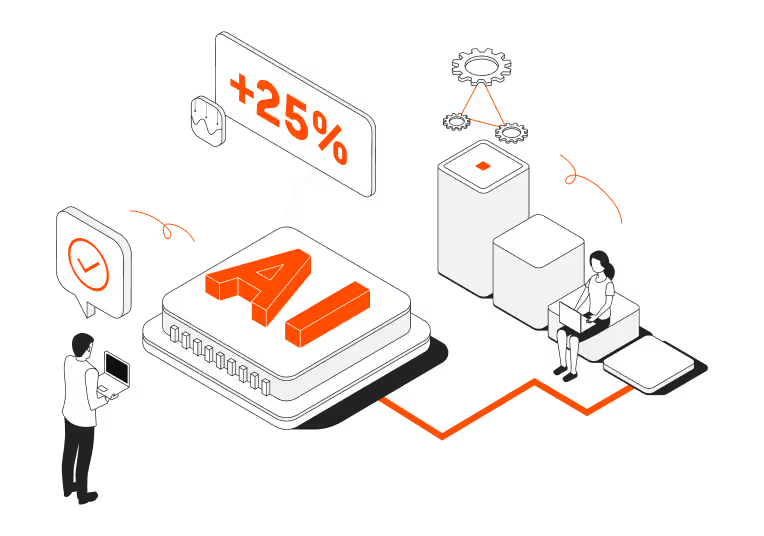
AI-augmented delivery with measurable impact
Our teams use AI across day-to-day delivery workflows, from coding and testing to analysis and documentation.
We track its impact through DORA metrics, and on selected tasks it can accelerate delivery by up to 25%.
Frequently asked questions
Business process digitalization is the process of transforming inefficient business operations - whether manual, paper-based, or poorly served by existing digital tools - into streamlined, purpose-built digital workflows. It goes beyond simply moving documents online or adding another off-the-shelf tool to the stack. It involves rethinking how processes work, identifying where automation, better data flows, custom software, and improved system architecture can reduce cost, minimize errors, and improve speed. This can include replacing manual data entry with automated systems, digitizing approval and reporting workflows, rebuilding or replacing digital tools that no longer fit the process, connecting disconnected systems so information flows where it's needed, and building custom software for processes that generic tools can't handle. The goal is to make your operations faster, more reliable, and ready to scale - not just digital for the sake of being digital.
Our digital transformation services combine consulting and implementation under one roof. On the consulting side, we assess your current operations, map existing processes, identify high-ROI digitalization opportunities, and build a digital transformation roadmap with clear priorities and milestones. On the implementation side, we design and develop the custom software, integrations, and digital tools needed to bring that roadmap to life. This includes everything from business process mapping and architecture analysis through MVP definition, UI/UX design, development, testing, and post-launch support. We don't just advise - we build what we recommend.
Business process automation focuses on making existing processes run faster by removing manual steps - often through software that replicates what a human would do (data entry, routing, approvals). Business process digitalization is broader: it questions whether the process itself is the right one before automating it. Digitalization may involve redesigning the workflow entirely, building new digital tools around it, connecting it with other systems, or creating user-facing applications that change how people interact with the process. In practice, automation is often a component of digitalization - but digitalization also includes strategy, architecture, user experience, and custom software development that automation alone doesn't cover.
A digital transformation consulting engagement helps you understand where you are, where you need to go, and how to get there - before committing to development. Our consulting process starts with an introductory session to understand your business goals and change motivations. Then we conduct interviews and workshops: as-is process mapping, stakeholder identification, architecture analysis, and goal-setting using frameworks like the Balanced Scorecard and SMART objectives. The output is a clear understanding of your current business state, defined digitalization goals aligned with your company vision, and a detailed action plan with KPIs for each identified goal. From there, we can move into a digitalization kickoff - defining MVP scope, timeline, and budget for the first implementation phase.
Our process has three main phases. The Digitalization Assessment uses interview calls or workshops to examine your current operations and identify areas that benefit most from digitalization - resulting in a teaser of tailored solutions and a general offer. Building a Digitalization Strategy goes deeper: using Business Model Canvas, architecture analysis, value proposition development, stakeholder mapping, Balanced Scorecard, and SMART goals to create a comprehensive strategy aligned with your business objectives. Implementing the Strategy turns insights into action through business context analysis, Business Process Mapping, Event Storming, and Story Mapping to define an MVP and deliver value efficiently. Each phase is designed around business process improvement - not just digitalization for its own sake - so every output connects back to measurable operational gains.
Timelines depend on scope. An initial digitalization assessment - interviews, workshops, and a recommendations teaser - typically takes 2–4 weeks. A full strategy engagement including process mapping, architecture analysis, and roadmap development usually runs 4–8 weeks. Moving into implementation, a focused MVP for the first digital solution can be delivered in 8–12 weeks. Larger digitalization programs involving multiple processes, integrations, and custom applications can span 4–12 months, delivered in phases. We scope every engagement so you see tangible results at each stage and can decide how to proceed based on real outcomes, not assumptions.
To begin effectively, we need access to the people who own or operate the processes you want to digitalize - operations managers, department leads, or anyone who can explain how things actually work today (not just how they're documented). Existing process documentation, workflow diagrams, or internal tools you currently use are helpful but not required - our assessment phase is designed to map all of this. The most important input is clarity on what's driving the change: rising operational costs, manual processes that don't scale, disconnected systems, compliance requirements, or competitive pressure. The more honest the starting picture, the more actionable the digitalization strategy will be.
Yes - this is exactly what the Digitalization Assessment phase is designed for. Many companies know they need to digitalize but aren't sure where to start or where the biggest ROI lies. We examine your current operations, identify bottlenecks, map dependencies between processes, and evaluate which areas would benefit most from digitalization based on impact, feasibility, and alignment with your business goals. The result is a prioritized list of opportunities - not a vague recommendation to "go digital," but a concrete plan showing which processes to tackle first, what the expected benefits are, and what resources are needed.
Both - and this is a key differentiator. We don't hand over a strategy document and leave implementation to someone else. Our digital transformation company combines consulting with custom software development, so the team that understands your business context is the same team that designs and builds the solutions. This eliminates the gap between strategy and execution that often derails digitalization projects. Whether the solution is a custom workflow tool, an internal portal, a mobile app for field teams, or an integration layer connecting your existing systems, we build it in-house with our engineering, design, and product teams. It's what sets us apart from digital transformation companies that separate strategy from execution.
Business process optimization through digitalization reduces costs through several mechanisms. Automating manual, repetitive tasks eliminates the time and labor associated with them. Reducing human error in data entry, reporting, and approvals prevents costly corrections and rework. Streamlining workflows removes redundant steps and handoffs that slow down operations. Connecting disconnected systems eliminates duplicate data entry and the reconciliation work it creates. And digitizing document-heavy processes reduces expenses related to handling, storage, and physical infrastructure. The cost impact compounds over time - as optimized, digitalized processes scale, they handle higher volumes without proportional increases in headcount or operational overhead.
Integration is a core part of every digitalization project, not an afterthought. During the assessment and strategy phases, we map your full technology landscape - existing applications, databases, internal tools, third-party services, and data flows between them. When building new digital solutions, we design integration layers that connect with what you already have - whether that's an ERP, CRM, legacy database, document management system, or a combination of these. Our approach prioritizes reliability (graceful error handling), maintainability (well-documented APIs and clear data contracts), and scalability (the integration should handle growing volumes without becoming a bottleneck).
Look for a partner that starts with your business processes - not with technology. The best digital transformation consulting services begin with understanding how your organization actually operates, where the friction is, and what outcomes you're trying to achieve. From there, technology choices should follow naturally. Ask whether the partner can take the work from assessment through implementation (not just produce reports), whether they have experience with custom software development (not just off-the-shelf tool configuration), and whether they bring product design and UX capability - because digitalized processes still need to be usable by the people who work with them every day. A good enterprise digital transformation services partner measures success by business outcomes (cost reduction, speed improvement, error reduction), not just project delivery.
Business process digitalization is most valuable for mid-sized and enterprise organizations that rely heavily on manual or semi-manual processes, operate across multiple departments or locations with disconnected workflows, struggle with data silos that prevent a clear operational picture, face scaling challenges because current processes don't handle growing volumes efficiently, or need to meet compliance and reporting requirements that manual processes make error-prone. Industries where we see particularly strong ROI include logistics and fleet management, manufacturing, financial services, energy and sustainability, and any organization where operational efficiency directly impacts margins and competitive position.
Our digitalization work spans several industries. In logistics and fleet management, we helped Autium digitalize their fleet incident management - automating insurance claims and accident reporting for fleet managers and drivers, replacing a manual process with a streamlined digital workflow. In renewable energy, we built a customer platform for Autarq that digitalized the sales process for innovative solar tiles, contributing to a 30% surge in sales. Also in the energy sector, we worked with Boston Solar on a custom modeling and proposal tool that shortened their sales cycle time by 33%. In agriculture, we digitalized remote management workflows for FarmDroid's autonomous field robots - turning complex operational processes into usable mobile and web interfaces. What connects these projects is the shared pattern: manual or fragmented processes that were limiting growth, and custom digital solutions that made those processes faster, more reliable, and ready to scale.
Business process digitalization projects involve significant upfront analysis - mapping existing workflows, documenting business rules, identifying dependencies, and defining requirements for new digital solutions. AI-augmented delivery helps accelerate this by supporting domain mapping, pattern recognition in process documentation, and faster synthesis of workshop outputs and stakeholder interviews.
In the implementation phases, AI assists with code generation, test automation, and documentation - reducing repetitive work so engineers focus on the business logic and integration challenges that are unique to your processes. To keep this disciplined, we follow Spec Driven Development: every feature starts with a validated specification and acceptance criteria before implementation. Engineers review all AI-generated output against the spec, ensuring the solution matches your actual business rules - not an AI's interpretation of them.
We measure the impact through DORA metrics, giving clients visibility into how AI supports faster delivery, fewer bugs, and shorter feedback loops. Based on feedback from our entire engineering team, AI can accelerate selected tasks by up to 25%. Every AI tool is vetted by our technical and legal teams, 94% of team members confirmed awareness of data security rules for AI usage, and no project data is ever used to train external models.
Expert advice for informed strategies




.svg)
.svg)
.svg)
.avif)

.avif)
.avif)
.avif)
