Key Takeaways
- IoT edge computing means processing data where it is generated, directly on the device or on a nearby gateway or server, instead of sending all raw data to a remote cloud data center.
- The edge extends the cloud rather than replacing it. Time-critical decisions happen locally, while the cloud handles long-term storage, historical analytics, and machine learning model training.
- The main business benefits are lower latency, lower bandwidth costs, better data privacy, and offline resilience. Critical processes keep running even when connectivity drops.
- Edge AI moves ML inference to the device. Anomaly detection, pattern recognition, and predictive maintenance can run in real time without continuous cloud access.
- Edge deployments bring their own operational challenges: managing device fleets, OTA updates, physical security of endpoints, protocol interoperability, and limited hardware resources.
- Not every workload belongs at the edge. Four factors decide it: required response time, data volume, connectivity conditions, and privacy or compliance requirements. A focused PoC or MVP is the safest way to validate these assumptions before scaling.
Transmitting every single byte of raw data to a remote data center for processing is often inefficient and unsustainable. It introduces crippling latency, drives up bandwidth costs, and creates severe operational risks if network connectivity suddenly drops.
This is where IoT edge computing steps in. By shifting processing power closer to where data is actually generated, businesses can build highly responsive, resilient, and cost-effective digital products. In this article, we will explore exactly what this technology is, how it works, and when processing data at the edge makes strict business sense. Because seeing the practical application of this technology is critical, this post exposes different real-world case studies.
Throughout the article, we will look at our work for FarmDroid, Biocore Mouthguard Sensors (MGS), SafeEx, GoMetro, and Poznań International Fair to show how different parts of the IoT data flow, from field devices to cloud platforms, work in practice.
What are IoT and edge computing
To fully grasp the value of IoT edge computing, it helps to first break down its foundational concepts and examine how they complement one another.
The Internet of Things (IoT) is a vast network of connected physical objects equipped with sensors, software, and communication technologies. These endpoints continuously collect data about their environment and operational status. From autonomous farming equipment to smart healthcare monitors, IoT is fundamentally about capturing real-world telemetry.
Traditionally, IoT architectures have relied heavily on centralized cloud servers to process all that collected information. Edge computing changes this paradigm. Instead of sending raw data thousands of miles away for analysis, edge computing brings computational power, storage, and networking physically closer to the data source—the "edge" of the network.
So, what is edge computing in iot? Simply put, it is the practice of analyzing, filtering, and processing data locally, either directly on the device or on a nearby server. Rather than replacing the cloud, edge computing in iot acts as a powerful, localized extension of it.
When you strategically integrate iot and edge computing, you empower the local network to make immediate, automated decisions. This means the iot edge ecosystem can instantly react to anomalies, while only sending the most critical or aggregated data back to the centralized cloud for long-term storage and advanced analytics.
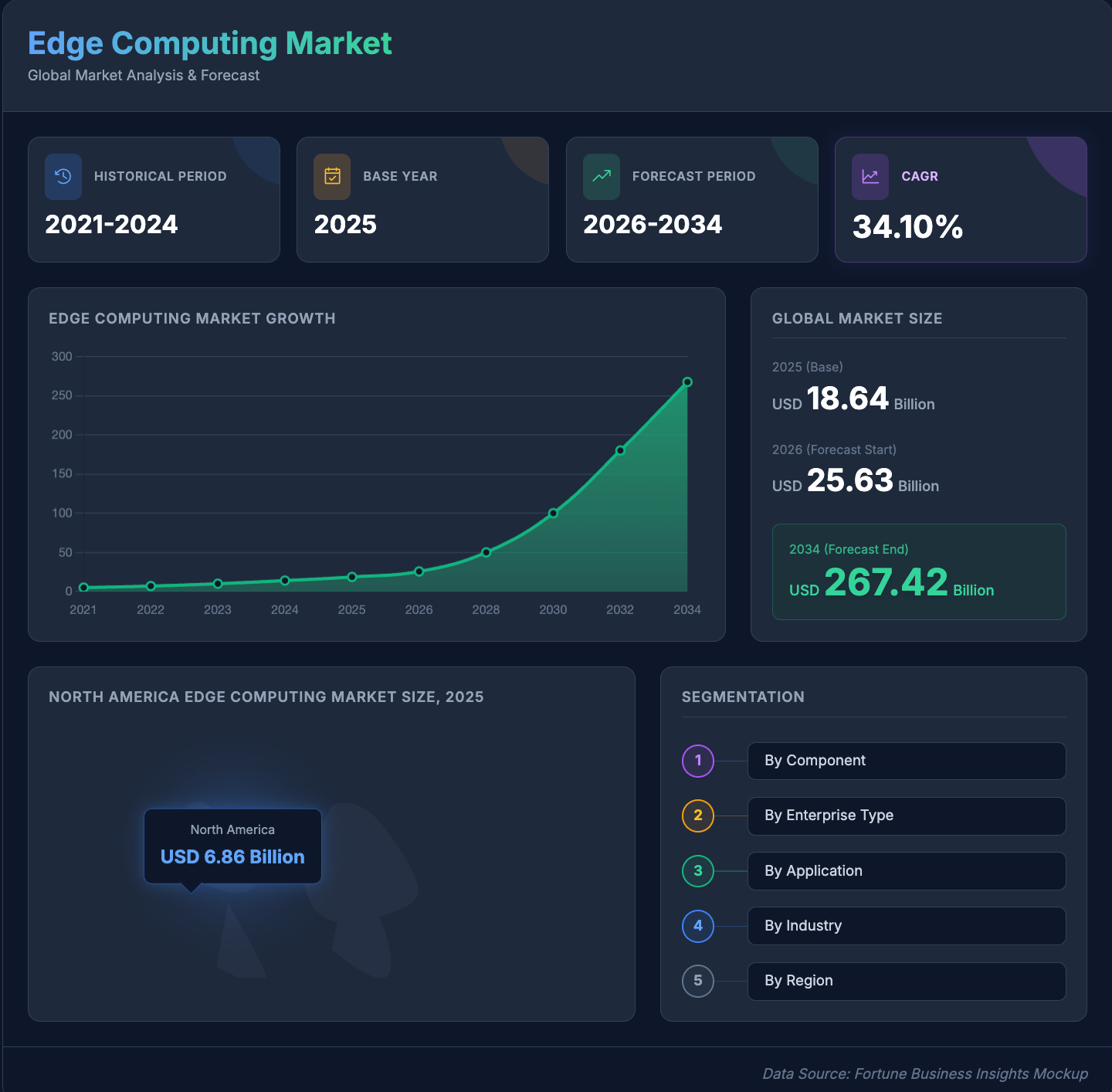
This shift is far from theoretical. It represents a major global infrastructure transition. According to Fortune Business Insights, the edge computing market was valued at ~$18.64 billion in 2025 and is projected to reach ~$267.42 billion by 2034, growing at a CAGR of 34.1%.
IoT devices, edge devices and IoT gateways
When discussing modern hardware architecture, terminology often gets tangled. To understand iot vs edge computing at a hardware level, it is essential to distinguish between the physical components that make up the network. People frequently ask, "what is edge devices?" and how do they differ from standard sensors or gateways? Here is a clear breakdown:
Together, these three elements form the backbone of modern edge devices iot networks, ensuring data is generated, processed, and transmitted efficiently.
How IoT edge computing works
To see the value of an iot edge network, it is helpful to look at the typical data journey. Implementing edge in iot transforms a linear "collect and send" process into a smart, five-stage flow:
- Collection: Sensors and IoT endpoints continuously gather raw environmental or operational data.
- Local Processing: Instead of waiting for cloud instructions, local hardware immediately analyzes the incoming stream via real-time processing.
- Filtering: The system applies strict data filtering rules to determine what is actionable immediately, what can be discarded, and what requires centralized storage.
- Automation: The edge system executes automated, real-time decisions—such as shutting down an overheating motor or adjusting a valve—without any cloud intervention.
- Cloud Processing: Only refined, high-value data is forwarded to the cloud for advanced analytics, machine learning model training, and global dashboarding.
Case Study Spotlight: FarmDroid
To see how IoT devices and remote software work together, consider our work with FarmDroid, a platform for remotely managing autonomous agricultural robots. FarmDroid's solar-powered field robots sow and weed crops autonomously. Our team built the web and mobile app that lets farmers, distributors, and FarmDroid's support team manage the robots remotely.
The app communicates with the robots via MQTT, a lightweight publish/subscribe messaging protocol widely used in IoT. Users can see a robot's position on a field map, track its movements in real time, and adjust its path by setting corner points and marking obstacles. An event overview lists the obstacles the robot encountered and the resulting errors, while the camera view adapts to the available connection, showing either still images or a live stream. The robot works autonomously in the field, and the app gives people visibility and control over it.
Benefits of edge computing for IoT
The shift toward decentralizing data processing is driven by concrete operational improvements rather than just technological novelty. When enterprises invest in edge computing for iot, they are directly targeting bottlenecks that traditional cloud architectures cannot overcome. The synergy between edge computing and iot unlocks several measurable business benefits:
- Latency reduction and faster response times: By eliminating the round trip to a remote data center, local systems can analyze data and trigger actions in milliseconds. This instantaneous response is non-negotiable for safety-critical systems, such as autonomous vehicles or industrial emergency shutdowns.
- Bandwidth optimization: Transmitting terabytes of raw sensor data daily is prohibitively expensive. Local processing ensures that only filtered, high-value data—or summaries of anomalies—are sent over the network, drastically cutting cloud storage and bandwidth costs.
- Data privacy and security: Sensitive information, such as biometric data or proprietary manufacturing metrics, can be processed on-site. Keeping this data within the local network reduces the overall attack surface and helps organizations comply with strict data residency regulations.
- Offline resilience: Distributed networks are not immune to connectivity drops. Processing at the edge ensures that critical processes continue to operate autonomously even when the internet goes down.
Case Study Spotlight: SafeEx
Offline resilience is a hard requirement in our work with SafeEx, an inspection tool for the oil & gas industry. The tool's mobile component is used by Ex Inspectors in locations with poor internet connectivity, such as offshore rigs.
As part of modernizing the decade-old platform, our team rebuilt the mobile app's synchronization API, using a Redis cache to keep processing stable and recover when the connection fails. Inspectors can sync their work at sea or on land without dropped connections or server errors compromising data integrity. The modernization also cut database queries roughly tenfold and made data views generate 10x faster.
SafeEx is not an edge AI deployment, but it shows a principle every edge project relies on: fieldwork cannot depend on a stable connection, and data must be reconciled reliably once the device is back online.
IoT edge vs cloud: architecture patterns
Businesses typically deploy a hybrid architecture that balances local execution with global cloud oversight. Depending on the specific latency and hardware requirements, this edge computing infrastructure can take several different structural forms:
- Device-level processing: The most localized tier, where computation happens directly on the smart sensor or endpoint (e.g., a smart camera running image recognition on its own internal chip).
- Fog computing: Rather than running on the device itself, processing is pushed to local area network (LAN) nodes, such as an IoT gateway or a local router, bridging the gap between the endpoint and the cloud.
- Micro data centers: Small, localized data facilities placed close to the geographical source of the data generation, often serving a specific factory, campus, or regional hub.
- Mobile edge computing (MEC): Closely tied to the rollout of 5G networks, mobile edge computing pushes computational capabilities to the edge of the cellular network (like cell towers or base stations). MEC enables ultra-low latency for mobile applications, autonomous fleets, and smart city infrastructure.

Ultimately, choosing the right edge computing platform means mapping these patterns to your operational needs—using the edge for real-time, localized action and reserving the central cloud for heavy data warehousing, historical analysis, and training machine learning models.
AI and machine learning at the edge
When combined with artificial intelligence and machine learning, localized computing reaches its full potential.
Traditionally, training complex AI models requires vast data sets and massive computational power, which remains firmly in the cloud. However, once a model is trained, running that model to make predictions (inference) can often be performed locally using lightweight technologies like TinyML.
Integrating AI into iot computing unlocks significant technical advantages:
- Local anomaly detection: Systems can instantly spot irregular vibrations in a turbine or thermal spikes in a server room without relying on continuous cloud connectivity.
- Real-time pattern recognition: Edge devices can process high-bandwidth inputs—such as video feeds or acoustic streams—and recognize patterns on the fly.
- Predictive analytics: By continuously monitoring real-time metrics, localized algorithms can forecast equipment failures before they happen, minimizing costly downtime.
Case Study Spotlight: Biocore Mouthguard Sensors (MGS)
Not every stage of an IoT data pipeline belongs at the edge, and our work on the Biocore Mouthguard Sensors (MGS) platform shows the cloud side of that equation. Biocore's smart mouthguards record head impacts sustained by athletes in contact sports. The sensor data is sent to the cloud, where machine learning algorithms turn it into impact readings for researchers developing safer sports equipment.
Our team designed and built the frontend that biomechanical engineers use to analyze this data after games and practices. It includes weekly, monthly, and per-game views, dashboards with 3D heatmaps and violin plots, a view for validating sensor readings and flagging faulty ones, and a custom video player with slow-motion playback and zoom for matching impacts with footage. Replacing manual data input made the engineers' analysis process four times faster.
The project shows when central processing is the right choice: the analysis is retrospective rather than time-critical, so there is no need to run ML models on the device itself.
IoT edge computing use cases
Across nearly every sector of the modern economy, enterprise iot deployments are moving from simple cloud monitoring to fully integrated iot edge solutions. By taking advantage of local processing, businesses across diverse verticals solve complex operational challenges that pure cloud systems simply cannot handle.
As the internet of everything connects billions of machines and physical assets, key industries are leveraging edge capabilities:
- Manufacturing & IIoT: In smart factories, an iiot edge framework powers predictive maintenance by monitoring machinery wear in real time. Instead of risking a costly production halt, edge controllers detect micro-vibrations, trigger automated safety interventions, and alert maintenance teams immediately.
- Healthcare: Medical devices and remote patient monitoring platforms rely on edge processing to analyze continuous vital signs locally. Immediate detection of cardiac anomalies or respiratory drops ensures alerts are issued instantly, even if hospital Wi-Fi experiences a temporary glitch.
- Autonomous vehicles: Self-driving systems must make millisecond decisions based on visual, radar, and LIDAR data. Relying on cloud processing for steering or braking is impossible; all critical safety logic must execute directly on the vehicle's edge hardware.
- Smart cities: Traffic management systems use local computer vision models to adjust signal timings based on real-time vehicle flow, reducing congestion and cutting emissions without overloading municipal networks.
Case Study Spotlight: GoMetro
In logistics, consider our work with GoMetro, a South African fleet management provider. Its Bridge platform uses telemetry to aggregate the locations of heavy-duty trucks into a single view for fleet operators and the companies leasing their trucks, even when fleets use trackers from different vendors. The goal was to optimize transport and digitize the cargo bidding process.
Our team built the user and admin portal and integrated it with GoMetro's telemetry system. Truck locations update in real time on a Google Maps view via WebSockets. The Smart Share feature lets a fleet owner share live location data with the company renting a vehicle for a period the owner defines, and the asset list shows whether each truck is in use or available for rent. The MVP shipped in about 18 weeks.
In this setup, the in-vehicle trackers are the IoT endpoints generating data, and the platform's value comes from aggregating those streams and controlling who can access them.
Challenges of running IoT at the edge
While the benefits are clear, architects must navigate complex hurdles when deploying edge iot devices at scale. Many organizations rush into deployments without fully anticipating the operational realities of distributed hardware. Moving compute power to the physical world introduces challenges that centralized data centers simply do not face.
- IoT edge device management: Managing a handful of devices is easy; managing a sprawling network of 10,000 remote endpoints is a logistical challenge. Effective fleet management requires specialized tools to monitor device health, track lifecycles, and diagnose hardware failures remotely.
- Over-the-air (OTA) updates: Software requires continuous patching for security and feature enhancements. Pushing OTA updates to remote devices without bricking them or causing downtime requires robust failover mechanisms, especially when edge connectivity iot is intermittent.
- Physical and network security: Unlike cloud servers locked inside guarded data centers, edge devices are often located in public spaces, factory floors, or remote fields. They are vulnerable to physical tampering, theft, and localized network breaches. Securing these endpoints requires hardware-level encryption and strict access controls.
- Protocol interoperability: Industrial environments are notoriously fragmented. Modern edge systems must frequently interface with decades-old legacy machinery, requiring extensive protocol translation to ensure seamless communication across the network.
- Limited hardware resources: Even advanced edge devices have strict constraints regarding power consumption, memory, and computational capacity. Developers must ruthlessly optimize their code and algorithms to run within these boundaries.
- Edge orchestration: Managing containerized applications across thousands of remote nodes is vastly different from managing cloud clusters. Engineering teams increasingly rely on lightweight Kubernetes distributions, such as K3s, specifically designed to orchestrate workloads efficiently in resource-constrained edge environments.
Edge computing in practice: smart city IoT at Poznań International Fair
Many of these challenges surfaced in our work on a smart city IoT system for Poznań International Fair. We co-initiated this year-long programme with the fair and the City of Poznań within the Poznań CityLab ecosystem, together with RCS Engineering, PSNC (Poznan Supercomputing and Networking Center), and the In_Spire Foundation. The testbed is the fair's East Hall: a 22-metre-high glazed space that can go from almost empty to thousands of visitors during major events, with sharp temperature differences between floor and ceiling.
The hall is monitored by 24 temperature sensors, a LiDAR unit, a thermal-imaging camera, and an air-quality sensor. Privacy was the defining constraint: the system tracks crowd density in a public space without capturing identifiable RGB imagery or biometric data. LiDAR produces point clouds instead of faces, the thermal camera records heat patterns instead of conventional video, and anonymisation happens at the edge, so only metrics such as the number of people in a given zone reach the central data layer.
Protocol interoperability and connectivity called for a pragmatic approach. Temperature sensors communicate with their hubs over RF 868 MHz, the hubs use Wi-Fi, and the LiDAR and thermal camera are wired via PoE. The temperature hubs could not publish directly to MQTT, so instead of forcing them into an architecture they did not support, we added an integration layer and normalised the data downstream, with an MQTT broker acting as the central data bus. Data travels through an isolated network segment and a VPN tunnel to PSNC's computing infrastructure, and containerised services are managed with Docker, Portainer, and k3s. The setup deliberately avoids relying on public cellular coverage, because the hall matters most precisely when it is crowded. The physical environment added its own constraints: sensors had to be mounted at height on 18-metre poles in a protected historic building, where winter condensation affects exposed hardware.
On top of this pipeline, we built a role-based app for facility managers and analysts. It includes 3D heat maps, an ISO 7730-based Comfort Score, a natural-language AI assistant, and a predictive temperature model that combines sensor readings, weather data, and planned attendance. The research period runs through February 2027, so energy and cost savings are not yet reported as outcomes. The system has, however, already collected data during peak events such as Poznań Motor Show and Pyrkon.
How to plan an IoT edge project
Successfully integrating iot and edge technologies requires meticulous planning and a pragmatic implementation roadmap.
This decision should be driven by four key factors:
Once you have identified the right workloads, focus on selecting an appropriate edge iot platform and the right iot edge computing devices that align with your environmental needs (e.g., ruggedized hardware for extreme temperatures).
Avoid the temptation to build the entire ecosystem at once. Partner with system integrators and a team experienced in custom software development for IoT to launch a focused proof of concept (PoC) or Minimum Viable Product (MVP).
Edge or cloud: making the right call for your IoT system
The exponential growth of connected devices makes it clear that the traditional model of relying solely on centralized data centers is no longer sustainable for modern, real-time applications. IoT edge computing naturally complements traditional architectures whenever low latency, reduced bandwidth costs, and strict operational resilience are critical to business success. By bringing computation to the physical source of the data, companies can build faster, more secure, and highly reliable digital ecosystems.
Whether you are looking to implement predictive maintenance on a factory floor or build a robust logistics telemetry platform, the right technical foundation is critical. If you are ready to modernize your infrastructure and harness the power of decentralized processing, explore Merixstudio's Custom Software Development for IoT services or reach out to our product engineering team to discuss designing and building your next IoT and edge solution.
FAQ
It is a decentralized computing architecture where the data generated by the Internet of Things is processed, analyzed, and acted upon locally at or near the device, rather than being sent to a distant cloud data center.
IoT refers to the network of connected physical devices and sensors that collect data. Edge computing is the method of processing that data locally. IoT generates the data; the edge processes it efficiently.
A smart factory deploying vibration sensors on a manufacturing line. Instead of sending all continuous vibration data to the cloud, an edge controller analyzes the data locally and instantly shuts down a machine if it detects an anomaly that precedes a failure.
Cloud computing relies on centralized data centers to process and store vast amounts of information, which requires continuous internet connectivity. Edge computing performs processing locally at the network's periphery, drastically reducing latency and enabling offline operation.
An IoT gateway is a physical device or software program that serves as the connection point between local edge devices and the cloud. It is needed to translate various local communication protocols into a standard format, provide local network security, and filter data before transmission.
Mateusz Lachowski
Senior Python Developer & Tech Leader
A Senior Python Developer and Tech Leader at Merixstudio, with a full-stack background that bridges cloud-native backend and physical IoT. He pairs deep expertise in Python, Kubernetes, and AWS with hands-on experience in Zigbee, smart-home automation, and electrical installations - a rare link between software and the physical world. He leads backend development for one of Merixstudio’s clients and has worked on projects ranging from a millions-record asset-management platform to backend engineering for the Expo City Dubai smart-city app and Juilliard’s recital-scheduling system. A Google Cloud Certified Associate Cloud Engineer, Mateusz cares most about clean, self-readable, performant code. Off the clock, he’s up for any new challenge that comes his way.
view more posts by Mateusz Lachowski

Marcin Łukasik
Content Writer
view more posts by Marcin Łukasik