.svg)


.png)
Key Takeways
- IoT security differs fundamentally from traditional cybersecurity, because edge devices lack the computing power to run standard endpoint protection and often sit physically exposed outside the network perimeter.
- Effective protection has to be built across three layers at once — device, network, and data — since hardening one while neglecting another leaves the whole system vulnerable.
- Default credentials remain the single most exploited attack vector, which is why unique per-device provisioning and certificate-based authentication matter more than any other single control.
- Secure boot, a hardware root of trust, and signed OTA updates determine whether a device can be trusted and patched throughout its entire lifecycle, while network segmentation prevents a compromised sensor from becoming an entry point to enterprise systems.
- Compliance is becoming a hard requirement rather than a differentiator, with the EU Cyber Resilience Act mandating SBOMs and lifecycle security support for connected products by December 2027.
In this complete enterprise guide, we will explore core iot security best practices, essential frameworks, and real-world case studies demonstrating how to design, deploy, and maintain secure connected systems.
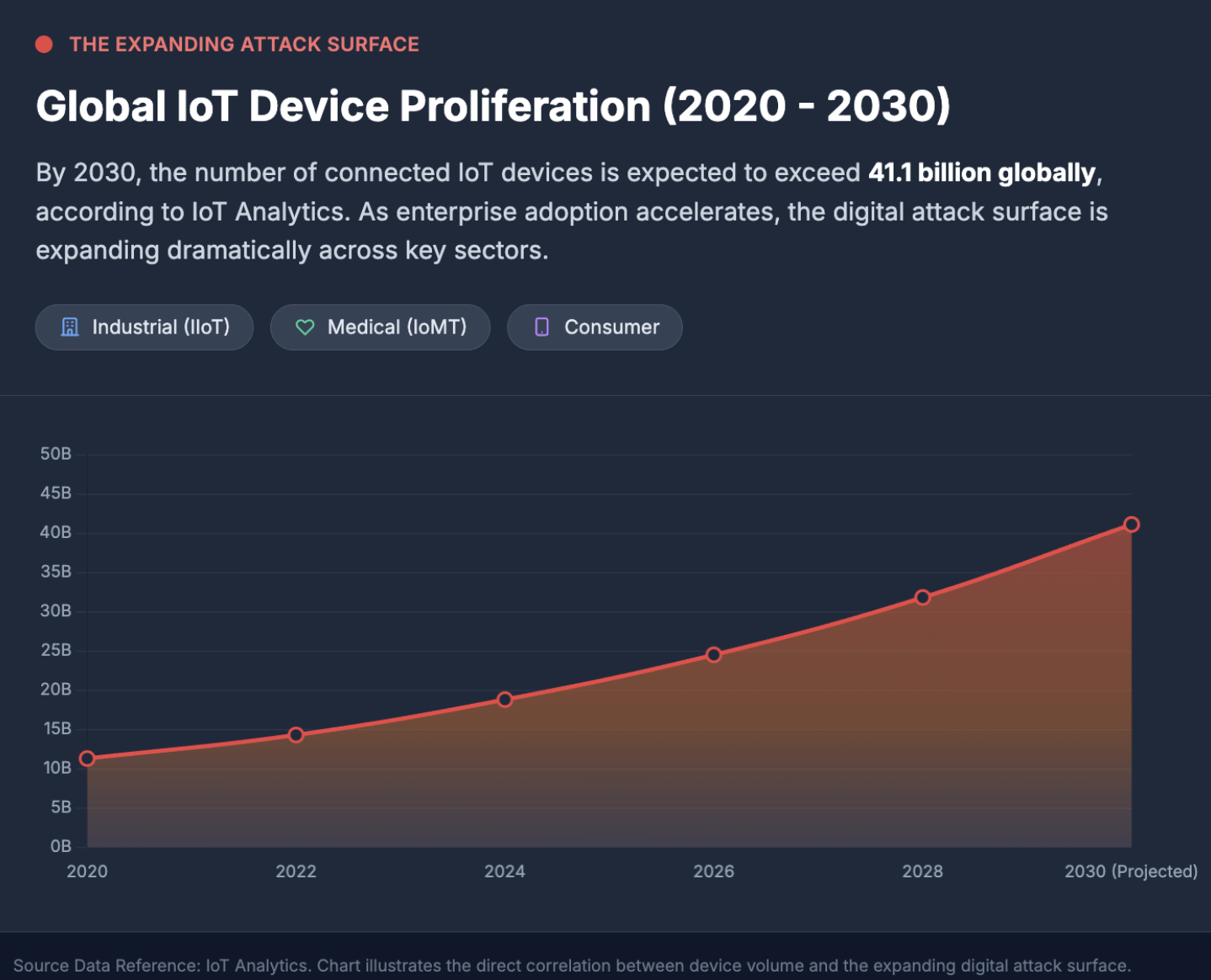
What is IoT security?
To understand what is internet of things security, we must view it as the comprehensive discipline responsible for protecting connected devices, the data they generate, and the backend systems they communicate with.
Historically, organizations relied on perimeter-based security, building a "moat" around the corporate network. Today’s IoT environments are distributed and heterogeneous. Devices sit outside the traditional perimeter, often in physically accessible public or hostile environments.
The core challenge of security in the internet of things is that most edge hardware lacks the computing power, memory, and storage to run traditional endpoint security agents. Consequently, securing these systems requires a fundamentally different approach, built across three primary layers:
- Device security: Hardening the physical hardware and embedded software.
- Network security: Controlling how the device communicates with the gateway and cloud
- Data security: Ensuring privacy, integrity, and encryption of the information processed.
Implementing robust iot security requires embedding protection at all three layers from day one.
The IoT threat landscape: key risks and real-world examples
Understanding how to prevent IoT attacks requires analyzing the real-world threat landscape. The flagship example of what unsecured devices can lead to remains the 2016 Mirai botnet attack. By compromising hundreds of thousands of vulnerable IP cameras and routers, Mirai generated a distributed denial-of-service (DDoS) attack exceeding 620 Gbps, the largest recorded at the time. Today, Mirai variants continue to evolve and actively target vulnerable infrastructure.
When assessing are IoT devices secure, organizations must confront several major threat categories:
- Default credentials: Confirmed by ENISA and NIST as the #1 attack vector in IoT.
- Expanding attack surface: Caused by rapid device proliferation and shadow IoT.
- Physical tampering: Unlike enterprise servers, IoT devices are often deployed in unmonitored public spaces, leaving them vulnerable to hardware extraction, reverse engineering, and direct local port access (e.g., JTAG/UART).
- Lack of secure firmware updates: Leaving devices permanently exposed to known CVEs.
- Data interception: Unencrypted transmission leading to data breaches.
- Compliance risks: Failure to meet stringent regulations like NIS2, HIPAA, or the strict data protection rules outlined in our GDPR compliance checklist.
Without proper iot protection, an organization risks not just data loss, but operational downtime, physical safety hazards, and severe regulatory fines. Effective iot device protection is no longer optional; it is a business imperative.
IoT device security best practices
Securing the device layer requires a joint effort between developers building IoT products and the enterprises deploying commercial devices. The following iot device security best practices are foundational for mitigating edge-level risks.
Change default credentials and enforce strong authentication
Factory-default usernames and passwords (like admin/admin) are the easiest entry point for attackers using automated dictionary attacks. To effectively secure iot devices, manufacturers must eliminate universal default passwords.
- Implementation Guidance: Provision unique credentials per device during manufacturing. Where feasible, enforce strict password policies or implement Multi-Factor Authentication (MFA) for administrative access. Better yet, transition away from passwords entirely by using Public Key Infrastructure (PKI) and digital certificates for device authentication.
Keep firmware updated using OTA mechanisms
Because devices are geographically distributed and physical recalls are cost-prohibitive, firmware management is a massive challenge.
- Implementation Guidance: A secure Over-the-Air (OTA) updates infrastructure is critical to protect iot devices. It should include a Hardware Root of Trust, cryptographically signed firmware packages to prevent malicious code injection, and automated rollback mechanisms if an update fails. Developers must account for OTA limitations in low-power embedded devices, optimizing update payloads for constrained networks. Knowing how to secure iot devices long-term relies entirely on patching them seamlessly.

Implement secure boot and hardware root of trust
Secure Boot ensures that a device only executes trusted, cryptographically signed firmware upon startup. This is a prime example of Security by Design implemented early in the Software Development Lifecycle (SDL).
- Implementation Guidance: Leverage hardware-based security such as a Trusted Platform Module (TPM), a Hardware Security Module (HSM), or ARM TrustZone. These create an immutable Root of Trust (RoT), ensuring that even if an attacker gains physical access to the device, they cannot load unauthorized firmware. This is the gold standard for iot hardware security.
Adopt a Software Bill of Materials (SBOM)
A Software Bill of Materials (SBOM) is a comprehensive, machine-readable inventory of all software components, open-source libraries, dependencies, and their specific versions running on a device.
- Implementation Guidance: Adopt standardized SBOM formats like SPDX or CycloneDX. By cross-referencing components against the NIST National Vulnerability Database (NVD), you can rapidly identify exposed devices when new zero-day vulnerabilities emerge. Furthermore, under the EU Cyber Resilience Act (CRA), SBOMs will become mandatory for all connected products sold in the EU by December 2027. Proper component tracking is non-negotiable for modern iot device security.
Network-level IoT security
Even perfectly hardened devices become severe risks if placed indiscriminately on a corporate network. This section outlines how enterprise administrators can build a secure iot infrastructure at the network layer.
Network segmentation and IoT VLAN isolation
IoT hardware should never share the same network as enterprise servers or employee workstations. The goal is to prevent lateral movement—if a smart thermostat is compromised, the attacker should not be able to pivot to the HR database.
- Implementation Guidance: Deploy dedicated network segments using VLANs, Software-Defined Networking (SDN), or microsegmentation. Follow the recommendations in NISTIR 8259 by placing strict firewalls between IoT environments and enterprise networks. A properly segmented architecture is the backbone of a secure iot network.
Gateway security, SWG, and VPN for IoT
The IoT gateway acts as the primary control point for edge traffic. Securing this chokepoint is critical for overall iot platform security.
- Implementation Guidance: Implement a Secure Web Gateway (SWG) to handle HTTPS/SSL inspection, URL filtering, application control, and remote browser isolation. For devices connecting over public networks, establish a Virtual Private Network (VPN) as a secure communication channel. Furthermore, integrate threat monitoring and Data Loss Prevention (DLP) at the gateway to detect anomalous data exfiltration.
Featured Case Study: RP Group
When modernizing the software for RP Group, Germany’s leading manufacturer of emergency lighting, Merixstudio faced the challenge of securely bridging C++ hardware with web platforms. We built a secure, scalable microservices architecture (Python, FastAPI, Vue.js, Docker) and conducted comprehensive penetration testing, culminating in a 72-page security assessment. This robust backend not only reduced manual inspection time by 70% but ensured that critical life-safety networks remained impenetrable.

API security for IoT cloud integrations
Cloud APIs are the nervous system of any connected ecosystem, handling device management and data exchange. Consequently, they are a primary target for attackers, vulnerable to broken authentication, injection attacks, and excessive data exposure (as outlined in the OWASP IoT Attack Surface Areas).
However, a secure system must also account for what happens when that cloud connection fails or is intentionally severed during an attack.
- Implementation Guidance: To ensure robust IoT application security, organizations must deploy centralized API gateways, enforce strict rate limiting, and validate all inputs. Furthermore, utilizing standardized authentication protocols like OAuth 2.0 or SAML for Single Sign-On (SSO) ensures that human operators, external software, and connected devices are securely authenticated.
- Designing for Resilience (Offline Mode): Device security must include fallback mechanisms if cloud integration is broken or compromised. Devices should be designed for "graceful degradation." For example, industrial sensors should feature local storage to cache critical telemetry data securely and push it once the cloud becomes online again. Similarly, critical control systems should support a fallback to a local network working mode, ensuring operational continuity even if the external API gateway is completely unreachable.
Data encryption and storage security in IoT
IoT ecosystems process highly sensitive operational, financial, and biometric data. Protecting this data across its entire lifecycle is the cornerstone of securing the IoT.
Securing data in transit and at rest
To prevent interception and tampering, data must be encrypted whenever it is moving or being stored.
- Implementation Guidance: Utilize Transport Layer Security (TLS 1.3) for all network communications. At the device and cloud storage levels, use strong cryptographic algorithms like AES-256, RSA, or Elliptic Curve Cryptography (ECC). Furthermore, implement a robust Public Key Infrastructure (PKI) for secure key management and digital certificates.
Featured Case Study: FarmDroid
FarmDroid develops autonomous field robots for sustainable agriculture. To enable farmers to manage these robots remotely, Merixstudio built an IoT platform using Node.js, Next.js, and Google Maps. Crucially, we designed a highly secure and scalable architecture leveraging real-time MQTT communication over encrypted data flows, ensuring operational commands and geolocation data remain tamper-proof while in transit.
.webp)
Privacy by Design and data minimization
Encryption alone does not solve privacy issues if you are collecting data you shouldn't have in the first place. Adhering to the principles of Privacy by Design means practicing data minimization—ensuring devices only collect, process, and transmit the data absolutely necessary for their primary function.
Featured Case Study: Poznań International Fair (MTP)
Applying Privacy by Design is critical in public spaces where mass data collection occurs. When the Poznań City Lab initiative required a user-facing platform for IoT facility management at the Poznań International Fair—a venue welcoming over 1 million annual visitors—Merixstudio partnered with the Poznań Supercomputing and Networking Center. The 22-meter-tall hall was outfitted with 24 temperature sensors, LiDAR, and thermal cameras to monitor environmental conditions.
Crucially, from a security and privacy standpoint, the system was designed with strict data minimization: the cameras do not record or collect recognizable image data of visitors. Instead, the raw telemetry is processed into anonymous 3D heat maps and airflow visualizations. This approach ensures facility managers get the precise, multidimensional data they need to optimize energy efficiency, without violating strict European privacy regulations (GDPR).
Building an enterprise IoT security strategy
Moving beyond individual controls requires building a comprehensive enterprise IoT security strategy. For CISOs and CTOs, the best iot security guidelines focus on process, lifecycle management, and continuous vigilance.
- Security Development Lifecycle (SDL): Embed security from day one across the seven SDL phases: Training, Requirements, Design, Implementation, Verification, Release, and Respond.
- Zero Trust Architecture (ZTA / ZTNA): Never trust any device by default, regardless of its network location. Verify explicitly, enforce least privilege access, and utilize Network Access Control (NAC).
- Continuous Monitoring: Implement anomaly detection. For example, if an industrial temperature sensor that typically transmits kilobytes of data suddenly begins streaming gigabytes of traffic, the system should automatically isolate it.
- Supply Chain & Vendor Risk: Manage the security of third-party vendors and plan for the eventual secure decommissioning of legacy hardware.
IoT security frameworks and compliance standards
Organizations need structured governance to build securing the iot: secure architectures. Depending on your industry, several key standards provide the necessary blueprints.
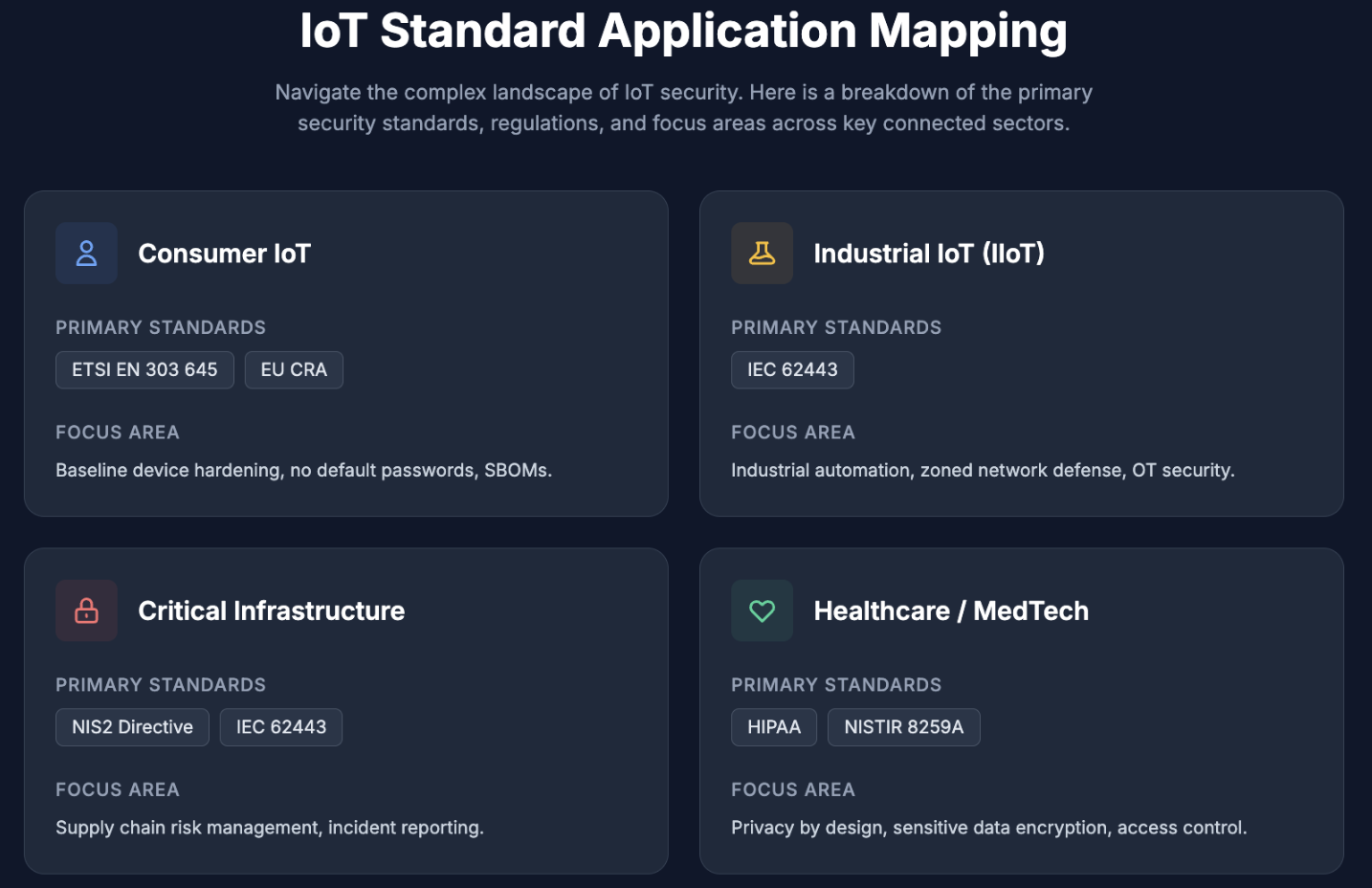
- NIST IoT Cybersecurity Framework (NISTIR 8259 / 8259A): Published in 2020, this is the foundational catalog of security capabilities for IoT devices. It covers the core baseline: Identify, Protect, Detect, Respond, and Recover.
- IEC 62443: The definitive standard for Industrial IoT (IIoT) and automation. It defines Security Levels 1-4, making it essential for manufacturing, energy, and critical infrastructure.
- ETSI EN 303 645: Adopted in 2020, this is the first global baseline for consumer IoT. It outlines 13 requirements, specifically mandating no default passwords and the creation of vulnerability disclosure policies.
- EU Cyber Resilience Act (CRA): Effective as of December 2024 (with full compliance required by December 31, 2027), this regulation mandates SBOMs, vulnerability reporting, and lifecycle security support for connected products sold in the EU.
- NIS2 Directive: Imposes strict incident reporting and supply chain risk management rules for organizations operating critical infrastructure.
Cloud security and data sovereignty compliance When scaling connected ecosystems globally, securing the data on the device is only half the battle; organizations must also navigate complex, region-specific data sovereignty laws. Cloud infrastructure must be configured to ensure that sensitive user and operational data is stored and processed in compliance with local regulations (such as GDPR in Europe, or specific cloud regulations in Asia).
- Implementation Guidance: When deploying global IoT and connected platforms, utilize cloud environments that offer localized data residency capabilities. Ensure that your cloud architecture complies with regional security requirements, applies role-based access control (RBAC), and uses secure cloud-native infrastructure (like AWS) configured specifically for the local legal landscape.
Featured Case Study: The Juilliard School
Managing complex, international operations requires strict adherence to local cloud security and data regulations. Merixstudio initially built a custom Recital Management System (RMS) in Python/Django to digitize Juilliard's complex scheduling processes in the US.
However, when the system needed to scale to the Tianjin Juilliard School in 2024, compliance with regional data laws became the priority. We successfully adapted and deployed the platform's infrastructure securely within AWS China, ensuring full regulatory compliance with local data sovereignty laws. This highly secure, localized cloud architecture not only met strict legal standards but also streamlined international operations, contributing to a 25% increase in ticket sales and heavily reducing administrative overhead.
Standard Application Mapping
Industries we build IoT software for
Because connected products rarely succeed on hardware alone, translating raw sensor data into secure, actionable insights requires industry-specific expertise. We build secure, compliant, and scalable custom software for IoT services across a variety of demanding sectors:
- Facility Management & PropTech: Software for managing building infrastructure, environmental monitoring, and connected systems in commercial and public spaces.
- Smart City & GovTech: Applications for urban monitoring, traffic management, public safety, and sensor-driven city services.
- SportsTech: Tools for field analysis, biomechanical data processing, and performance monitoring in professional and research environments.
- Healthcare & Medtech: Interfaces for connected medical equipment, patient monitoring, and clinical data management—with strict privacy and regulatory compliance built in.
- Industrial & Manufacturing: Software for predictive maintenance, production line monitoring, quality control, and highly secure factory automation systems.
Conclusion
Effective IoT security requires a deeply layered approach. It begins with device hardening through secure boot and unique credentials, relies on network security via strict segmentation, ensures privacy through encryption, and is sustained by a robust governance strategy and adherence to compliance frameworks.
Connected products rarely succeed on hardware alone. At Merixstudio, we build custom software for IoT. With over 25 years of experience, ISO 27001 & ISO 9001 certifications, and AI-augmented delivery that accelerates timelines by up to 25%, we design secure architectures (MQTT/TLS, encrypted data flows) where Security by Design is embedded from the earliest development stages, never added as an afterthought.
FAQ
IoT security encompasses the strategies and technologies used to protect connected devices and networks. It matters because unpatched or poorly configured devices serve as gateways for attackers to breach corporate infrastructure and cause physical, financial, or data-related damage.
Isolate them using VLANs or microsegmentation so they cannot communicate directly with critical enterprise systems. Additionally, ensure all traffic passes through a secure gateway.
The most prevalent vulnerabilities are hardcoded default credentials, lack of encrypted communications, insecure APIs, and the inability to receive OTA firmware updates.
Implement a Hardware Root of Trust, enforce secure boot, mandate unique credentials, use TLS 1.3 for communications, and actively monitor network traffic for anomalies.
Start with NISTIR 8259A as a baseline. Use IEC 62443 for industrial applications, and ETSI EN 303 645 for consumer products. European operators must also comply with the NIS2 Directive and the upcoming EU Cyber Resilience Act.
They are not inherently insecure, but their limited computing power and memory mean they cannot run traditional security software, requiring security to be built into the hardware and software architecture by design.
Zero Trust dictates that no device is trusted by default. Every connection request from an IoT device must be authenticated, authorized, and continuously validated before access is granted.

Marcin Łukasik
Content Writer
view more posts by Marcin Łukasik

Mateusz Lachowski
Senior Python Developer & Tech Leader
A Senior Python Developer and Tech Leader at Merixstudio, with a full-stack background that bridges cloud-native backend and physical IoT. He pairs deep expertise in Python, Kubernetes, and AWS with hands-on experience in Zigbee, smart-home automation, and electrical installations - a rare link between software and the physical world. He leads backend development for one of Merixstudio’s clients and has worked on projects ranging from a millions-record asset-management platform to backend engineering for the Expo City Dubai smart-city app and Juilliard’s recital-scheduling system. A Google Cloud Certified Associate Cloud Engineer, Mateusz cares most about clean, self-readable, performant code. Off the clock, he’s up for any new challenge that comes his way.
view more posts by Mateusz Lachowski

.svg)
.svg)
.svg)
.avif)

.avif)
.avif)
.avif)
