.svg)



Key Takeways
- B2B software handles complex relationships between organizations - multiple users, different permission levels, integrations with external systems.
- Custom software gives you full control over the roadmap and a competitive edge you can't buy off the shelf.
- The Total Cost of Ownership of a custom solution over 3-5 years often comes out ahead of rising subscription costs.
- Choosing the right technology partner might determine a project's success more than the choice of technology itself.
That's the point where CTOs, CEOs, and product managers start asking the same question: is it time to build something of our own?
And it's a question that comes up for good reason. According to McKinsey, more than 80% of B2B companies hold their e-commerce channel to the same standard as their other sales channels, and 35% of corporate decision-makers say they're willing to spend $500,000 or more on a single digital transaction. Digital has stopped being an add-on to B2B sales - it's become the core of it, and standard SaaS tools increasingly can't keep up with what that core requires.
B2B software development is the process of designing and building software made to handle the relationships between businesses - from sales platforms and ERP systems to supply chain tools and dedicated applications for business clients. It's one of the most demanding corners of business software development, since it combines technical complexity with the need to understand a client's specific business model. This guide covers what sets B2B software apart from consumer applications, when custom development makes financial sense, what the process actually looks like, and how to choose a partner who won't leave you with an unfinished project.
What is B2B software development?
B2B software development means designing and building software for use by other businesses - as opposed to B2C software, which goes to individual consumers. Put simply, it's the set of solutions that automate processes between companies - from CRM, ERP, and B2B e-commerce platforms to tools for managing projects, logistics, and data. That definition sounds simple, but it hides a fundamental difference in how the software looks, how it works, and what it demands from the team building it.
A consumer app needs to be intuitive for one person who downloaded it onto their phone and expects it to work right away. B2B software has to serve an organization: dozens or hundreds of users with different roles and permissions, purchasing processes that involve several departments at once, integrations with ERP, CRM, or EDI systems that have been in place for years, and compliance requirements specific to a given industry - GDPR, SOC 2, HIPAA, PSD2. It's a different usage model, a different rollout cycle, and entirely different project priorities.
B2B software covers two distinct scenarios. The first is internal software - tools built for a company's own operations: an ordering platform for a distribution network, a fleet management system, a CRM tailored to a non-standard sales process. The second is a product sold to other businesses as a service - a proprietary SaaS tool used by business clients. Well-known B2B software products include Salesforce, SAP, and HubSpot, alongside thousands of niche solutions built to order for specific companies. In both scenarios, the technical requirements are similarly complex, and the stakes around how - and with whom - you build are just as high.
Whatever the scenario, B2B software solutions all come down to the same question: a ready-made tool, or B2B custom software designed around a specific process?
Benefits of custom B2B software vs. off-the-shelf solutions
The off-the-shelf vs. custom software question comes up in almost every conversation about B2B custom software development. Ready-made solutions have one clear advantage - fast deployment. The trouble starts once the business grows and that tool starts feeling like a pair of shoes a size too small. If you're still weighing the decision, the video below walks through when it makes sense to shift to custom development.
The biggest practical difference comes down to this: with custom development, the software adapts to how the company works - not the other way around. In industries with unique operating models - logistics, insurance, facility management - that difference translates directly into operational efficiency. Relying on SaaS also means relying on the vendor's roadmap decisions: when a new feature will ship, when an old one will disappear, whether the platform will even be around in two years. With a custom solution, those decisions stay with the company.
Total Cost of Ownership - numbers that catch people off guard
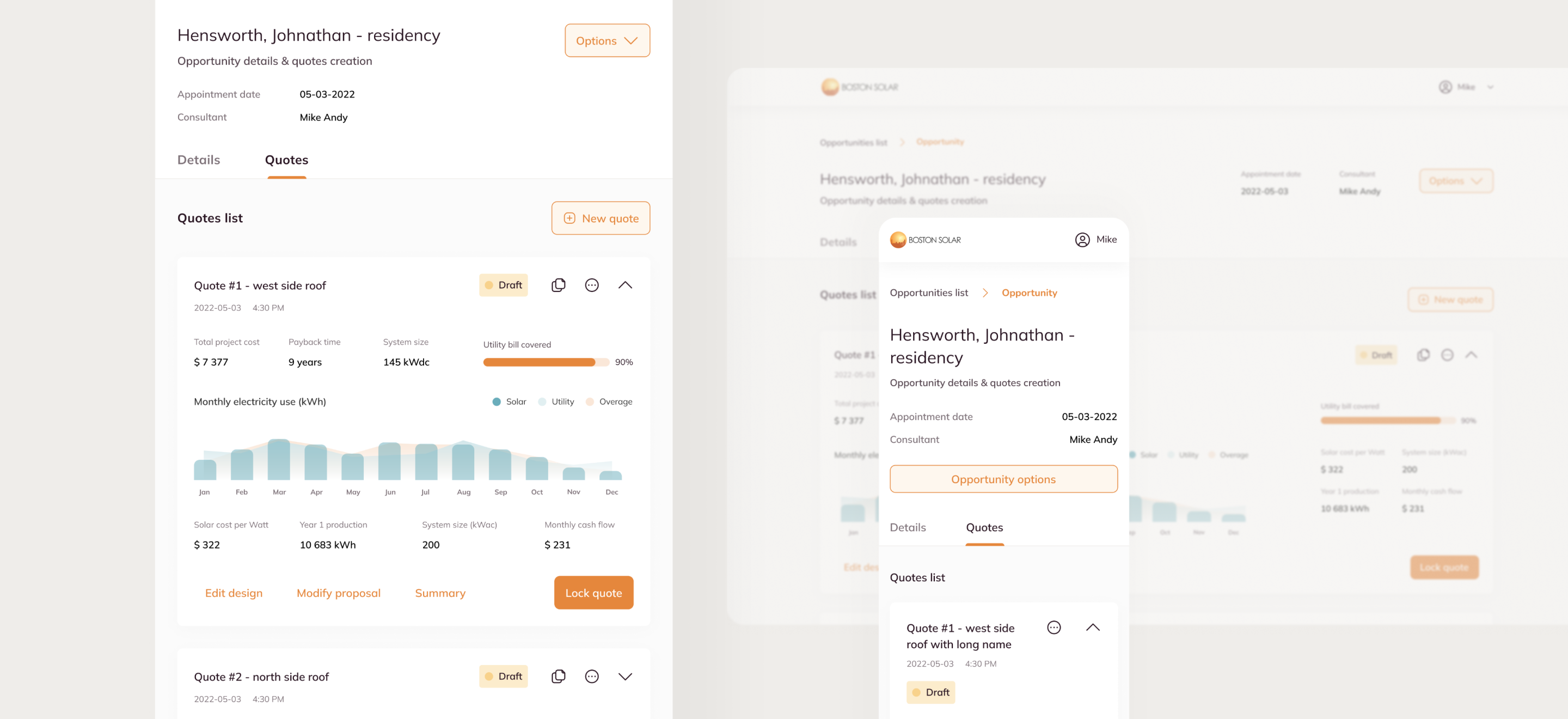
At first glance, off-the-shelf SaaS looks cheap. But after a few years, the bill starts adding up: rising subscription costs, fees for extra modules and integrations, and the cost of outside specialists brought in for customization. When companies put those numbers next to the real cost of building their own solution, the picture often looks very different from what they expected. One of our clients, a solar energy company, replaced a fully manual, Excel-based sales process with a custom CRM and project management platform - the result was a 33% faster sales cycle and roughly $1.4M in added revenue, the kind of return a subscription tool alone couldn't have delivered.
Most of the companies use off-the-shelf software - including the competition. Custom software builds an operational edge that simply can't be purchased. And then there's security: in B2B projects, a single piece of software processes data for dozens of clients at once. Custom software lets you design a security architecture around your specific requirements - GDPR, SOC 2 Type II, HIPAA, or PSD2 - instead of relying on whatever the SaaS vendor decided to roll out for everyone. Merixstudio itself works to ISO 27001 and ISO 9001 standards on client projects.
B2B software development process: step by step
One of the biggest mistakes companies make when entering B2B software development is assuming the project starts with writing code. In reality, code doesn't show up until you're already halfway there. That earlier stretch is where the real complexity lives: B2B processes in particular tend to carry years of accumulated exceptions and industry-specific logic that no outsider absorbs on day one. The whole software development lifecycle - from the first conversation about requirements to years of ongoing support - runs as a single continuous process, with each stage feeding directly into the next.
That's the lesson experience across similar projects has reinforced for us, and it shapes how we start every engagement. For a smaller or less-defined project, that often starts with a Scoping Recon: a short working session built around a client's existing documentation and open questions, ending in a rough estimate and a recommended next step before any commitment is made. Larger, more demanding enterprise environments call for something heavier: a dedicated audit and consulting phase before development begins at all. Throughout, an AI-augmented approach to both discovery and delivery keeps that groundwork moving quickly without cutting corners.
Requirements gathering and discovery
The discovery phase software development teams treat as the starting point, is the first and most important stage. Its goal isn't to compile a feature list - that's too narrow a view. Proper software requirements gathering means talking to actual users of the system and setting SMART goals, not just writing down a wish list. The client-side Product Owner plays a critical role here: someone who understands the business and can make scope decisions in real time. That said, a strong client-side PO isn't the only safeguard - a big part of what separates a good partner here is having its own structured process and tools for extracting the real requirements, not just taking a wish list at face value. For a closer look at how that works in practice, see this breakdown of gathering requirements in IT projects. Concretely, that means workshops that bring stakeholders from different departments into the same room to map out business events before jumping to user stories - and a good session usually surfaces something about the client's own business that even the client didn't fully see going in; if nothing new comes out of it, that's often a sign the process didn't go deep enough. It also means separating the solution a client asks for from the problem underneath it: someone asking for 'a website' may actually need something that solves a completely different operational bottleneck. For more on how we approach that early diagnostic stage, see what we do to understand a product.
.webp)
Architecture design and technical planning
Once requirements are clear, it's time for technical decisions that will hold for years to come: how the software will scale alongside the company and how hard it will be to maintain three years down the line. A good software partner can explain those decisions in business terms, not just technical ones.
Development and iteration
Development work runs in sprints - usually two-week cycles, at the end of which the client sees working software, not just a slide deck of progress updates. Agile software development catches misunderstandings early, instead of delivering the whole project at the end in one big bang drop. Regular client demos are part of the process, not a bonus.
Testing and quality assurance
Testing should be built into the process from day one (shift-left testing) - a bug caught during development costs a fraction of the same bug found after launch. At the end comes UAT, the user acceptance testing the client's own people run.
In practice, our testing spans five areas, and the mix is matched to each project:
- Functional and regression testing - confirms that new features work as intended and that recent changes haven't broken anything already live.
- Automated end-to-end testing - speeds up repetitive checks across web and mobile using frameworks like Cypress and Appium, so more can be verified in less time.
- Performance and load testing - reveals how the system holds up under real traffic (with tools such as k6 and Locust) before users ever feel a slowdown.
- API testing - verifies the connections between services and third-party integrations, using tools like Postman and Axios.
- Accessibility, standards, and production monitoring - checks the product against WCAG 2.2 and W3C standards, and tracks errors in the live product with Sentry to catch issues early.
Deployment and go-live
A well-executed go-live includes infrastructure setup, monitoring from day one, and a contingency plan. The standard here is a CI/CD pipeline - a process that ensures every code change passes through testing before it reaches production.
Maintenance, support, and evolution
Launch isn't the end of the project - it's the start of a new chapter: fixing bugs, applying security updates, scaling, and evolving the product. It's worth setting the terms of this phase before signing the contract - companies that only think about maintenance after launch often discover they're more dependent on the vendor than they'd like.

B2B software development models: custom build, SaaS, and outsourcing
Once the case for custom software is clear, a more practical question follows: how should that software actually get built - in-house, through an outside partner, or some combination of the two?
Building with an in-house team gives full control but requires a capable IT department and the highest upfront costs - an option for companies where software is core to the business. Buying off-the-shelf SaaS is the fastest route to a working tool, but with limited room for customization. That limit tends to stay invisible until you hit it - and in our sales conversations, hitting it is one of the most common reasons companies come to us about custom development in the first place.
The pattern is especially clear with the low-code and no-code platforms popular for early builds. Several companies we've spoken with built their first product or MVP this way, then reached a ceiling as they grew:
- An online education platform ran on a ready-made video-hosting service, but rising licensing costs and limited room for functional growth pushed them to weigh the three-year cost of custom development against staying put.
- An accessibility-focused startup built its MVP on a no-code app builder, hit performance and functional limits, and moved to plan a rebuild on a custom stack.
- A wellness company ran its proof of concept on a mix of no-code and automation tools - but scaling brought compatibility issues, data-security concerns, and integration gaps (like the lack of a "buy now, pay later" option), pointing to a custom rebuild as the only viable path.
- A valuation firm built a client portal on a low-code tool but hit "a wall of how much we can tweak and improve the UX/UI," and needed a custom stack to support 75% annual growth.
- A B2B software company built on low-code, hit a ceiling on scaling and feature development, and hired a VP of Engineering specifically to lead the migration to a custom stack.
- A language-services provider operating on WordPress reached its performance and scalability limits, and is exploring a fully custom, code-based application to support internal processes and future expansion.
- An insurance brokerage was constrained by a licensed, template-based CMS - and, noticing that market leaders rely on custom solutions, is seeking a custom build to stay competitive.
The common thread: off-the-shelf and low-code are often the right call at the start. The trick is recognizing when you're nearing the ceiling, so moving to custom is a planned step rather than an emergency.
Software development outsourcing to an external custom software development company combines the flexibility of custom software with no need to maintain a full in-house IT department. Within outsourcing, it's worth distinguishing between nearshoring and offshoring. Nearshore software development - working with companies in Central and Eastern Europe - means closer time zones and strong technical talent at lower costs than Western Europe. Poland is a common starting point for exactly this reason. Offshoring to Asia offers lower rates, but the bigger time difference complicates communication. There's also a middle ground: team augmentation, adding specialized developers to an existing in-house team without recruitment costs or a long-term commitment.
Decision framework: custom or SaaS?
- Are your processes fairly standard, or do they have unique characteristics that don't fit a ready-made tool?
- Does your organization's scale demand flexibility that SaaS can't offer?
- Can your budget absorb higher upfront costs in exchange for a lower TCO over 3-5 years?
- Is your project timeline measured in years rather than months - and does the software need to become a competitive edge?
If most of your answers are "yes", custom development is the right direction. If your processes are standard and your budget and timeline are tighter, off-the-shelf SaaS is often enough.
Industries that rely on B2B software
Almost every industry has its own needs when it comes to B2B software, but in a handful of sectors, dedicated solutions - including advanced B2B web application development - are especially common.
In healthcare and MedTech, regulatory requirements are the strictest of all. EHR systems, telemedicine platforms, and software that pulls in data from diagnostic devices all need to meet HIPAA standards, support the HL7 FHIR data exchange format, and protect patient data at a level no generic SaaS tool can guarantee.
Fintech and financial services require tight integration with PSD2 and Open Banking. With that level of compliance complexity, an off-the-shelf solution rarely fits without compromises that carry real legal consequences.
In logistics and supply chain, digitizing processes translates directly into operational savings. TMS, WMS, and shipment tracking platforms need to integrate with dozens of partners and support EDI from day one.
B2B e-commerce is a market that's grown fast in recent years. Ordering platforms, product configurators with thousands of variants, and systems for managing individual trade terms go well beyond what consumer-facing platforms can handle. We've built this kind of infrastructure for global brands - including a custom product information management platform used by 100+ companies across corporations like Mars, P&G, and Carrefour's distribution network.
.webp)
In manufacturing and Industry 4.0, software meets hardware. MES, IoT integration with machinery, and predictive maintenance all need to run in real time - a system failure here means a halted production line. The same reliability demands show up in adjacent industrial sectors - we built a safety inspection platform for oil and gas companies where inspectors work offline on drilling platforms, with data syncing only once they're back online.
Companies building their own SaaS product are a category of their own: organizations whose product is the software itself - HR tools, analytics platforms, specialized industry software. Here, B2B software development is the foundation of the business model, not just an operational tool. We saw this firsthand building an AI scheduling platform for enterprise HR teams that cut planning time by roughly 90%.
Key challenges in B2B software development
B2B software projects have a reputation for being difficult. Knowing the most common software development challenges makes them easier to avoid.
One of the most frequent reasons projects go over budget is scope creep in software development - the gradual expansion of scope beyond what was originally agreed. Each new feature looks small on its own. Add them up, and you get months of delay. The fix is a clearly defined change process, with every change priced for its impact on the timeline before it gets approved.
Most B2B companies enter a project with an existing ecosystem - older ERP or CRM systems with incomplete API documentation. Legacy system integration is often the riskiest part of the whole project, and a good partner assumes that uncertainty up front, building a proper buffer into the schedule. It's a pattern that shows up again and again in why modernization projects fail more broadly - technical debt rarely sinks a project on its own, but an underestimated integration almost always compounds it.
Data migration is just as commonly underestimated. Years' worth of accumulated inconsistencies and duplicates need to be mapped and cleaned before anything moves to the new system. Skip that step at the estimation stage, and you're setting yourself up for chaos at launch.
B2B software handles data for multiple clients at once, so data isolation and RBAC need to be designed in from the start, not bolted on as a fix later. A separate challenge is onboarding end users: client-side employees without a technical background push back against unintuitive tools, which often means a return to old processes. Getting this right starts well before launch, with real user research - understanding how these employees actually work day to day, not just what the process documentation says - so the software fits existing habits instead of fighting them.
With outsourcing, there's also the challenge of managing a distributed project. The fix is a clear reporting model, a dedicated Project Manager, and regular check-ins on a sprint rhythm - not just at major milestones.
How to choose a B2B software development partner
The question "how to choose a software development company" comes up in every conversation with a decision-maker facing this choice. It's a decision that shapes the next several years - get it wrong, and it's not just wasted budget, but delays and, in the worst cases, a system you have to rebuild from scratch. For a broader rundown of what to weigh, see our guide on finding a reliable IT outsourcing partner.
Every software partner has a portfolio on its website. What matters more is whether you can talk to real clients who completed similar projects - industry, scale, type of integration. If that's not on offer, that's a red flag. It's worth asking to see named, verifiable projects, not just an anonymized case study or a logo wall - we, for instance, can point to a digital signage CMS platform running in production for named enterprise clients including Volvo, IBM, Adidas, Porsche, and DHL.
.webp)
The tech stack should be current and compatible with your ecosystem. More important than the list of technologies is whether the company understands the trade-offs between different choices and can explain them without jargon.
There are two basic billing models: time-and-material and fixed-price. T&M gives you flexibility as requirements shift; fixed-price gives you budget predictability, but requires a precisely defined scope up front. Neither model is inherently better - what matters is whether the partner prices scope realistically and shows you progress regularly. A third approach has been gaining ground: value-based pricing, where the fee is tied to the business outcome delivered rather than the hours worked or a fixed scope. This shift is partly driven by AI - as AI-assisted development speeds up how quickly code gets written, pricing purely by time starts to make less sense, and the conversation moves toward the results the software actually produces. It's not a fit for every project, since it depends on defining measurable outcomes both sides agree on up front, but it's worth understanding as a direction the market is moving in.

Check security certifications (ISO 27001, SOC 2 Type II), especially in regulated industries. Look into team stability too - high employee turnover is an underrated red flag. Project knowledge lives in the heads of the people working on it; when they leave, the project loses its memory.
This is exactly the kind of scrutiny we'd invite for our own team. Merixstudio holds ISO 27001 and ISO 9001 certification, maintains a 4.8-star rating from 96 reviews on Clutch, and keeps team turnover on long-running B2B projects low enough that project knowledge stays in-house instead of walking out the door with a departing developer. That's backed by established development processes - from responsible, reviewed use of AI in the codebase to reusable boilerplates that speed up delivery without cutting corners on quality.
It's also worth checking whether a partner genuinely understands your business goals, not just the backlog in front of them - look for teams that include business analyst roles and ask pointed questions before proposing a solution. That's the approach we take too: not just advisors, and never "yes-men" - we ask tough questions, challenge assumptions, and give honest feedback, then bring ideas to life with full-stack teams. It also means true ownership: mature project and risk management that let us take full responsibility for delivery, so your team can focus on core innovation.
B2B software development trends
Companies investing in custom development today are building systems that will be in use for five years or more. It's worth knowing where the industry is headed - especially as investment in software is growing faster than the IT market as a whole. According to Gartner forecasts, global software spending is set to exceed $1.4 trillion in 2026, growing 14.7% year over year. For companies investing in B2B software, that's a signal that budgets aren't disappearing, and expectations of vendors will only keep rising.
That growth is tied to a bigger shift: AI in business software is now standard practice - not a chatbot on the homepage, but AI built into business processes: document analysis, demand forecasting, CRM lead scoring. AI in software development is no longer an add-on module; it's becoming the foundation of the architecture, even if specific ML models get added later. We apply the same logic to our own delivery: AI as a "copilot" that speeds up specific, well-defined tasks - not something that replaces the judgment of a senior engineer or gets anywhere near client code without human review (we've written about how that governance works in practice). The same shift shows up in what clients are asking us to build for their own businesses - an AI-powered design platform that lets non-designers in large organizations produce on-brand content without touching a design tool.
.webp)
None of this works in isolation, either. Modern B2B software is built around open APIs that support integration with a broad ecosystem of tools, and the shift away from monolithic systems toward microservices lets individual modules be developed and replaced independently.
That kind of modularity also changes what "scalable" means in practice: designing for native cloud operation is becoming the standard - a system that can handle far more users at peak times without maintaining expensive infrastructure year-round.
More infrastructure exposed to the cloud also means more regulatory scrutiny: growing requirements - the NIS2 Directive, the AI Act - and the Cyber Resilience Act (CRA) - are pushing companies to treat security as part of the architecture from day one. The CRA is worth watching in particular: it sets mandatory cybersecurity requirements for products with digital elements across their entire lifecycle, with vulnerability-reporting duties starting 11 September 2026 and full application from 11 December 2027. Enforcement carries real weight - fines can reach €15 million or 2.5% of global annual turnover - which is why enterprises are already building CRA readiness into how they design and maintain software rather than treating it as an afterthought. are pushing companies to treat security as part of the architecture from day one. Zero trust, end-to-end encryption, and regular penetration testing are becoming standard practice.
None of that matters if people don't want to use the software day to day: business users now have the same expectations as consumers, and they're increasingly impatient with clunky interfaces at work. That extends to B2B web development more broadly - client portals are now judged by the same standards as consumer apps. Companies that build B2B software with a strong UX standard in mind gain an edge over competitors who treat the interface as an afterthought. For a closer look at what that actually means in practice, watch the video below.
Summary
B2B software development is an investment that pays off steadily over time: better operational efficiency, lower process maintenance costs, and an edge that competitors can't simply buy from a SaaS vendor. It's also a demanding undertaking - technically complex, spanning many months, and requiring more than one person's involvement on the client side.
The key to success is choosing a partner who understands both the technical and the business side. And there's a third factor that's harder to measure but often decides things in practice: culture fit. Technical competence and domain knowledge can be checked against a portfolio; culture fit - whether the two teams communicate in the same way, share a similar working rhythm, and simply get along - only shows up in how the collaboration actually feels day to day. It rarely appears on a requirements list, yet it's frequently what tips a decision one way or the other, because a partner you trust and work well with is a partner you can build with over the long term. If you're planning an investment in dedicated B2B software, talk to our team - we can help assess the scope and plan a project built to succeed.
Sources
McKinsey & Company, "Busting the five biggest B2B e-commerce myths," January 2022
Gartner, "Gartner Forecasts Worldwide IT Spending to Grow 10.8% in 2026, Totaling $6.15 Trillion," February 2026
FAQ
It's the process of designing and building software for other businesses - as opposed to B2C applications aimed at consumers. It covers internal operational tools (ERP, CRM, ordering platforms) and SaaS products sold to other businesses, with an emphasis on integrations, security, and support for multiple users with different permission levels.
B2B software has to support multiple users with different roles, integrations with business systems, and high compliance requirements. B2C focuses primarily on simplicity for a single user.
A simple internal tool or an MVP can be built in 3-4 months. A complex enterprise system typically takes 9-18 months. A reliable estimate requires running a discovery workshop first.
Cost depends on scope, the number of integrations, and compliance requirements. A simple tool typically runs $50,000-$150,000, while a complex enterprise platform can range from $300,000 to several million dollars. It's worth comparing those numbers against the TCO of off-the-shelf SaaS over a 5-year horizon.
It depends on the complexity of your processes, how unique your requirements are, your budget, and your time horizon. If your processes are fairly standard, off-the-shelf SaaS is often the better choice. If the software needs to support unique operations or become a product for your own business clients, custom development is the only path forward.
Scope creep, underestimated complexity of integrating with legacy systems, neglected data migration, and testing introduced too late. On top of that, there are communication challenges with a distributed team and end-user resistance to new software.
Key criteria: a portfolio of similar projects with access to real references, up-to-date technical skills, a transparent collaboration model, security certifications, and team stability. Be wary of companies that price a project instantly and without asking questions.

Aneta Mitura
Content Writer
Content marketing specialist and project manager with over 10 years of experience
view more posts by Aneta Mitura

Miłosz Kusiciel
Head of Technology
Head of Technology at Merixstudio with over 17 years of experience in software development and tracking emerging trends. He defines and executes Merixstudio's technology strategy, ensuring solutions are scalable, secure, and aligned with real business goals rather than technology for its own sake. In recent years, he has led the responsible adoption of AI within the company and played a crucial role in achieving ISO 9001 and ISO 27001 certifications - a concrete signal of his commitment to engineering quality and information security standards. Miłosz is an active member of ITCorner and Poznan City Lab, and a regular speaker at tech events like Pozitive Technologies and Tech of Tomorrow.
view more posts by Miłosz Kusiciel
.svg)
.svg)
.svg)
.avif)

.avif)
.avif)
.avif)
