Key Takeaways
- Scandinavia has a growing startup and VC ecosystem but a shortage of software developers.
- Denmark alone could face a gap of 19,000 software and electronics specialists by 2030.
- Rising demand and limited local talent keep developer salaries and outsourcing rates high across Nordic countries.
- Hiring an in-house team gives better communication but can strain a startup's budget early on.
- Offshore partners in Poland offer skilled developers, minimal time zone gaps, and lower costs than Scandinavia.
The Scandinavian region has a growing local ecosystem with its main tech hubs and VC firms. There are many companies based in the Nordic regions which invest in software. Creandum (Sweden), Verdane Capital (Norway) or NorthZone (Sweden) are good examples. Worthy of note is the fact that not only local firms are investing in Scandinavian businesses, but many European companies are doing that too.
Big problem: lower supply of developers than demand
Let’s take Denmark as an example. According to Danks Industri, the confederation of the Danish industry, Denmark is becoming one of the European leaders in the field of software development. Scandinavia attracts companies such as IBM, Uber Software Development as well as IT bigwigs such as Microsoft.
With this in mind, you probably won’t be surprised by the fact that there is a very high demand for software specialists and graduates in the Nordic region. Mads Tofte, rector of the IT University of Copenhagen said that in 2016 they had doubled their intake - “instead of applying to the Danish Ministry of Education for a grant like we usually do, we financed this expansion ourselves because the need is too acute.”
In spite of the popularity of IT studies, it is estimated that only Denmark will lack 19,000 software and electronics specialists by 2030. The same applies to other Scandinavian countries. There is no doubt that there will be a big hindrance in the future when it comes to access to experienced software developers.

It could be a huge problem to solve for Nordic startups and businesses in general. And also it can be a big opportunity for software outsourcing companies in other Europe countries such as Poland.
In Poland, we offer access to highly qualified software developers, and Poles are good at using new tech solutions. Polish startups’ development is also fast and vast, and we’ve been specializing, in general, IT where software development has the lion’s share. I won’t lie if I say that few of the most impressive solutions in the world are based on Polish skills. For instance, Google and other big IT fish employ Poles in great numbers. It feels that Poland became one of the best places to outsource developers offering the best quality.
Startups need software development
Not every, but most of the startups are based on software solutions. When there are any of the dev members in your team, it could be a huge problem.
Let me lay your options out for you here.
Hiring an in-house team
The quite common approach is hiring developers for in-house development. The main advantage is communication matters. But it’s rather a tricky solution. There are many reasons for outsourcing web development instead of hiring an in-house team. The biggest of the cons is the cost. In the case of limited funds at the beginning, it can be a startup killer.
Let’s get back on Scandinavian countries. How much should you pay for developers in Sweden, Denmark or Norway? It turns out that the Nordic region is one of the most expensive regarding software development outsourcing as well as consulting services.
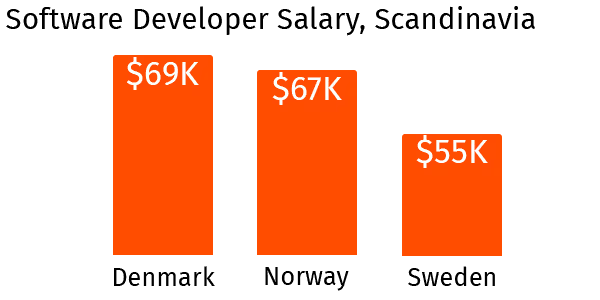
According to PayScale, the average developer's annual salary in Denmark is almost $70K, depending on experience (wages in Denmark rank as the world’s third-highest). Norwegian programmers can count on a salary of from about $65K to $82K (4th place in the world’s rank). The average developer salary in Sweden is about $55K (6th place in the world's salaries rank).
However, the average price for an hour of work of developer in Scandinavia comes close to $39-$55. But the recommended pricing category is $51-$100 per hour due to the quality.
The need for technical skills is growing, and the supply of tech talents is still lower than the demand. So, we can expect that developers will continue to negotiate higher wages in the future.
Hiring software developers for offshore development
If the money is a big deal for you (and I’m sure it is) and the budget is crucial, the perfect solution is to offshore software development. In this case the whole development process in on the neck of a remote team.

I believe you’ll be happy, especially if you’re not a tech person, that you have a dedicated remote team that will tackle your needs and take full responsibility for the quality. There are some disadvantages of this solution: language barriers, unclear rules of work, problems with communication. But the best IT outsourcing companies should get it covered. Top development teams clarify all the factors I mentioned above. They also have a tremendous experience, so if something were wrong, you would know.
What about Poland?
Are you a startup in the early stage? Or a big company looking for the top development team that will tackle your needs? No matter. Eastern Europe and destinations like Poland can be the best bet for you. There are many reasons why Poland is one of the best places to outsource developers. One of them is small or no time zone differences. Speaking of Scandinavia, we’re dealing with the second option - any time differences between Poland and Nordic countries.
However, the most important reason (and the one we are the proudest of) Poland has become outsourcing heaven is flexibility and the talent pool of young devs. As I mentioned at the beginning of this piece, they are hired by small and big international firms. It’s because of their excellent communication skills (it’s said that Poles know three languages: Polish, English, and Programming) and great knowledge.
If you’re not sure, check out ranks such as Clutch.co and its Leaders Matrix.
FAQ

Anita Soczka
Head of People & Culture
view more posts by Anita Soczka